
Rachel’s Towing & Recovery · 24/7 Dispatch
A Port Town Gets Busy on a Schedule. Breakdowns Do Not.
Stopped on 401 while four thousand people are trying to reach a ship, or sitting on A1A with a fence where the shoulder should be. Call, hear what to do right now, and have a pink truck routing around the crush.
(321) 728-1869 answered live, day and night
Cape Canaveral, FL
Half the Drivers Around You Have Never Been Here Before.
That is the thing that makes a breakdown in this town different. On most roads in the county, the traffic around a stopped car belongs to people who drive that road every day and read it without thinking. Here, a large share of it is rental cars and shuttle vans full of people who landed this morning, are watching a phone for directions, and are looking for a terminal number rather than for you.
Drivers who do not know a road brake later, drift wider, and change lanes with less warning. So the margin you would give yourself somewhere familiar should be bigger here. Get further off the pavement than feels necessary. Put more distance between yourself and the lane than you think you need. If your hazards are on and you are standing where a distracted visitor could reach you, you are too close.
None of that is a reason to panic. It is a reason to be deliberate in the first minute. Hazards on immediately, and if the car still rolls, use that to reach somewhere with real ground beside it rather than stopping the moment the engine quits.
Where the Fence Line Leaves You Nowhere to Go.
There are stretches around here where the road runs beside a fence or a barrier with essentially no shoulder, and the usual advice stops working. The standard rule is that everyone gets out through the doors on the side away from traffic, walks back behind the car, and gets well clear of the pavement. That rule assumes there is somewhere to walk to.
When there genuinely is not, meaning a barrier at the pavement edge and a live lane beside you, the safer choice flips. Stay belted inside with the hazards flashing, doors closed, and call 911 before anything else. A car with flashers running is a far bigger and more visible object than a person standing in a gap two feet wide, and there is no retreat on foot from a spot like that anyway. Same answer if anyone is injured or you are stopped in a moving lane. Police first, then us, and the two calls do not conflict.
Where there is ground, use it. Behind the car and away from the road, never in front of it, and never in the space between the car and a rail.
Getting off the road first is not us being careful. It is the only part of this you control.
Rachel’s Towing & RecoveryThe Turnaround Hours Are Predictable. Plan Around Them.
Anybody who has lived here a while can tell you roughly when the port area gets thick. On sailing days, a big block of arrivals converges on the same connections in the same few hours, then a matching block leaves. Taxis, hotel shuttles, luggage vans, and a river of rental returns all move at once. It is not chaos, it is just a lot of vehicles funneled through a small number of routes.
For a tow that means two honest things. First, dispatch quotes you the road as it actually is at that hour rather than a hopeful number, and if the answer is longer than you want to hear, you will hear it anyway. Second, priority is set by exposure, not by who called first. A car parked safely in a lot can wait. A car with people standing beside a live lane cannot.
Tell dispatch what time you need to be somewhere. If there is a ship to catch, say it in the first sentence. That is not something dispatch can guess and it changes how the run is handled.
Wind Off the Atlantic Is Not a Detail.
Being on the ocean side means the wind here has nothing to break it. On a blustery day it comes across the open stretches hard enough to matter for two practical reasons.
Standing near the edge of a road in a strong crosswind is worse footing than it looks, and it gets considerably worse if you are holding a car door or a child’s hand. And a person on foot is much harder for an approaching driver to pick out than a stopped vehicle with flashers. Those two facts point the same direction: if the spot you are in does not have real ground and real distance, being inside the car is the better bet until help arrives.
Tell dispatch it is windy where you are. That sounds like small talk and is not. It changes how the driver positions the truck when he pulls up and how much room he gives himself to work.
What to tell dispatch, in this order
- The road and the nearest mile marker or cross street.
- Whether you are off the pavement or still in a live lane.
- Year, make, model, and whether the wheels turn.
- How many people are with the vehicle.
The Sentence That Gets a Truck to You Fastest.
A visitor should never feel bad about not knowing the road names. Nobody expects that. What dispatch needs is anything that puts you on a map, and there is usually plenty in sight.
- Whether anyone is hurt, and whether traffic is still moving past you in a live lane.
- The nearest hotel, terminal number, marina, or business sign you can read from where you sit.
- Which way the ocean is from you and which direction you were driving.
- Year, make, color, and whether the car still rolls and steers.
- A dropped pin by text, which settles it instantly and takes ten seconds.
You will hear the price for the run before a truck leaves the yard. No mystery number at the end, and nothing added because you sound like you are from out of town.
Sometimes the Truck You Need Is a Smaller One.
A good share of these calls turn out not to need a tow at all. A dead battery, a flat, an empty tank, or keys locked in a rental is roadside work, handled where you sit, and you drive away instead of following anyone. If there was any contact between vehicles, accident and collision towing runs off the same board with no second call. A bike takes its own straps through motorcycle transport, and anything past pickup weight belongs to the heavy fleet.
If the car simply quit somewhere safe, that is a standard tow. If the drivetrain or the ride height means all four wheels have to come off the ground, dispatch sends the flatbed instead. You do not need to know which one applies. Describe what happened and the right truck gets assigned. Everything we run in this end of the county is on the Cape Canaveral coverage page, the service is laid out on the emergency towing page, and the gallery shows the trucks you will be looking for. Prefer to type? Send dispatch the details.
Stopped near the port with a ship to catch? Somebody is awake.
(321) 728-1869Called In From the Terminal Lots.
Not here? A dispatcher can answer it in ten seconds. Call at any hour.
(321) 728-1869I am in a rental car, I am not from here, and I have no idea what road I am on. Can you still find me?
My ship leaves in two hours and my car quit. What are my options?
There is no shoulder at all where I stopped. Do I get out or stay in?
How long do the port arrival and departure hours slow you down?
A truck is stopped behind me with its flashers on. Is it safe to walk over and talk to the driver?
Is a live person answering at four in the morning?
Flashers On, Get Clear, Then Call the Number.
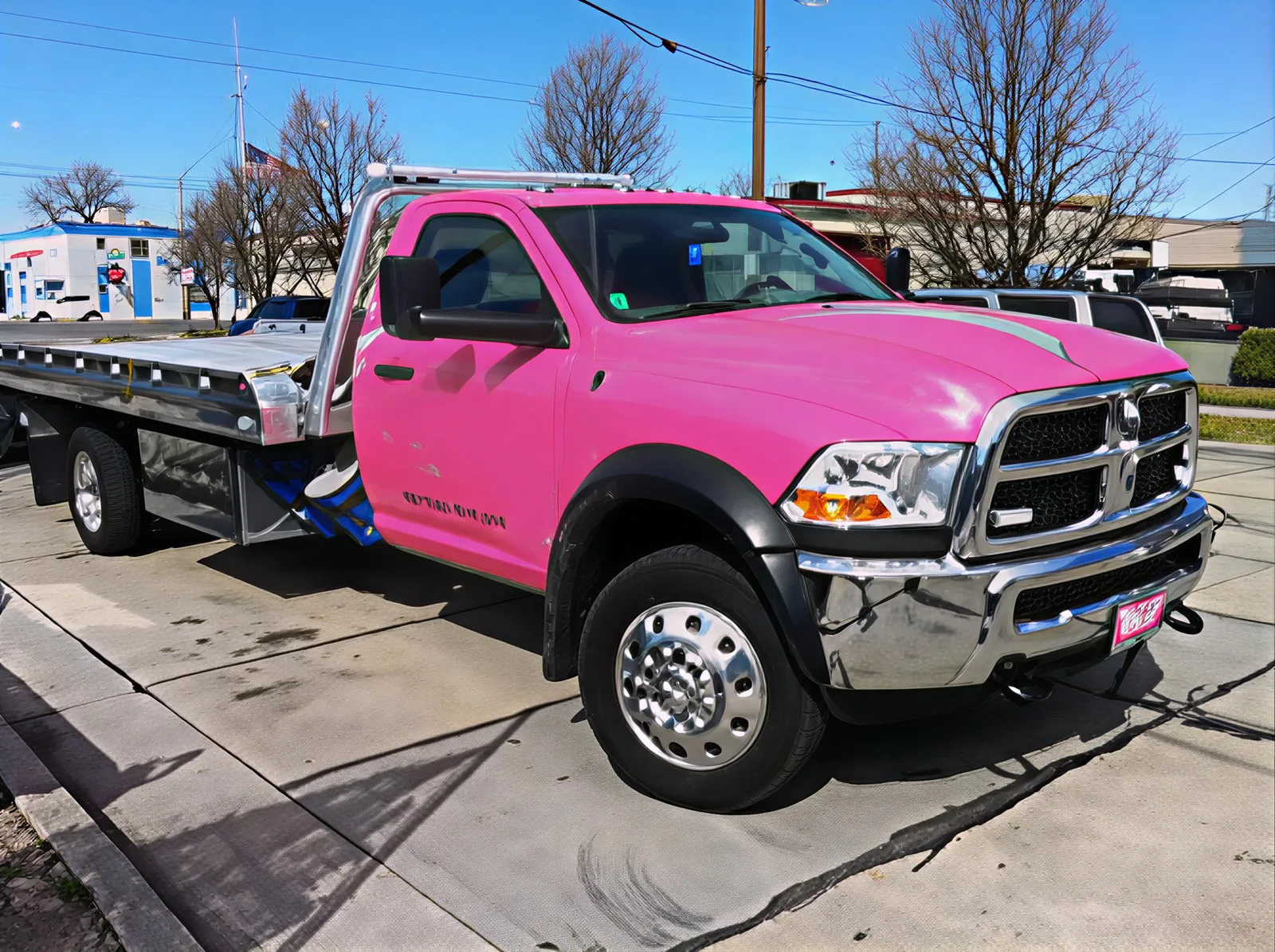
A live dispatcher takes what you can see, who is with you, and whether there is a clock on your day, quotes the run before it leaves the yard, and sends something bright pink you cannot miss.
(321) 728-1869Nobody in danger? Send dispatch the details or look through the pink fleet at work.