
Rachel’s Towing & Recovery · 24/7 Dispatch
Water on Both Sides Turns a Dead Car Into a Real Problem.
Break down between the rivers and walking home is not an option. Cars, SUVs, minivans, whatever quit on Courtenay Pkwy or in a lot off 520. Live dispatch, an honest arrival time, and the full price settled on the phone.
(321) 728-1869 answered by a person, always
Merritt Island, FL
Geography Makes This a Worse Place to Break Down.
On the mainland, a car that quits is inconvenient. Somebody comes and gets you, or you walk to a coffee shop and wait. Here, the same failure has a river on either side of it. If you live beachside and your car dies near Courtenay Pkwy, or you live on the island and it dies after you crossed 520 west, the vehicle and the driver are separated from home by a bridge nobody wants to walk.
That is the thing this town’s tow calls have in common, regardless of what broke. The mechanical problem is ordinary. The situation around it is not, and it is why so many of these calls include the sentence “and I need a ride too.”
Say that on the phone. A driver can take one passenger in the cab on most runs, and knowing before he leaves is better than sorting it out in a parking lot at dusk.
What Actually Quits on a Daily Driver Here.
The failures are the same everyday ones you would see anywhere, and worth naming plainly because people call apologizing for not knowing what is wrong.
Alternators are the most common thing behind a car that ran fine an hour ago. Once the charging system quits, the vehicle is living on stored battery power, which is enough for a commute and not enough to restart after you park. A jump gets it moving. A jump does not fix it.
Starters go with warning, usually. Slow crank, then two turns of the key, then one click. Fuel pumps stall a car mid-drive and refuse to prime afterward. Transmissions on higher-mileage vehicles tend to fade rather than snap: slipping on the ramp, a hard shift, then a morning when the engine revs and nothing happens.
And then there is the largest category of all, which is “it will not start and I have no idea why.” Nobody needs a diagnosis to call a tow truck. The mechanic figures out the cause. We handle the part where the car has to get to the mechanic.
Most of what we do is not dramatic. It is a dead battery in a driveway and somebody who needs to get to work.
Rachel’s Towing & RecoveryShift Work, Badges, and Cars That Quit at the Worst Hour.
A lot of this island commutes north to work, on schedules built around a gate rather than a nine-to-five clock. That produces two versions of the same call.
The first is the car that will not start before a shift. Being late is not a small thing when you are badged in somewhere with a fixed start time, and that is why dispatch here is a person at four in the morning rather than a machine taking a message. The second is the car that dies during a shift, where the owner cannot leave to meet the driver. Give dispatch the name and number of someone who can be there and say where the keys will be, and the run happens without you.
Either way, tell us the time you can actually be present. Scheduling around a badge-out is normal work here, not an accommodation.
520, Courtenay, and Knowing Which Road You Are On.
Merritt Island is long north to south and the roads through it behave completely differently depending on the hour. The 520 corridor toward the beaches loads up in the afternoon and on any weekend with decent weather. Courtenay Pkwy runs the length of the island and takes shift traffic. The causeways in both directions are choke points that can turn a ten-minute drive into thirty.
None of that stops a truck. It changes the number dispatch gives you. So when you call, say which side of the island you are on and which crossing you are near. A driver heading into the 520 corridor at four in the afternoon takes a different route than one who thinks he has a clear run, and you get an arrival time that reflects the road as it actually is instead of the road on a quiet Tuesday.
Gated subdivisions along the water get the same treatment. The code, the guard-house situation, and any low canopy over the entrance cost nothing to mention on the phone and everything to discover at the gate.
Tell dispatch this and it goes faster
- Year, make, and model, plus whether it is running at all.
- Exactly where it sits: driveway, lot, shoulder, or garage.
- What happened right before it quit.
- Where you want it taken, if you already know.
The Price Gets Settled Before Anything Moves.
You hear a number for the whole job while you are still on the phone. The vehicle, where it sits, and where it is going are enough to quote it, and if anything at the scene turns out to be different from what was described, you hear that before the car is hooked up rather than afterward on an invoice.
Destination matters here more than in most towns because it decides whether you cross water. A shop on the island is a short run. A dealer in Cocoa or a mechanic somebody has trusted for fifteen years down in Melbourne is a longer one. We have no shop arrangement and no reason to steer you, so if you are undecided, ask for both numbers and pick with the figures in front of you. Plenty of these runs simply end at your own driveway while a part is on order, and that is a perfectly good answer.
Calls That Belong Somewhere Else on This Site.
Not everything needs a tow. A battery, a lockout, a flat, or an empty tank is roadside work, and hiring a tow truck to handle one is paying for the wrong visit.
If the vehicle is all-wheel drive, sits very low, or has a wheel that will not turn, flatbed towing covers why the deck matters. If you are stopped right now on a causeway shoulder with traffic close, emergency towing is the faster call. Collisions run through accident and collision towing, bikes go on motorcycle towing, and anything past the weight of a large pickup goes to the heavy-duty fleet.
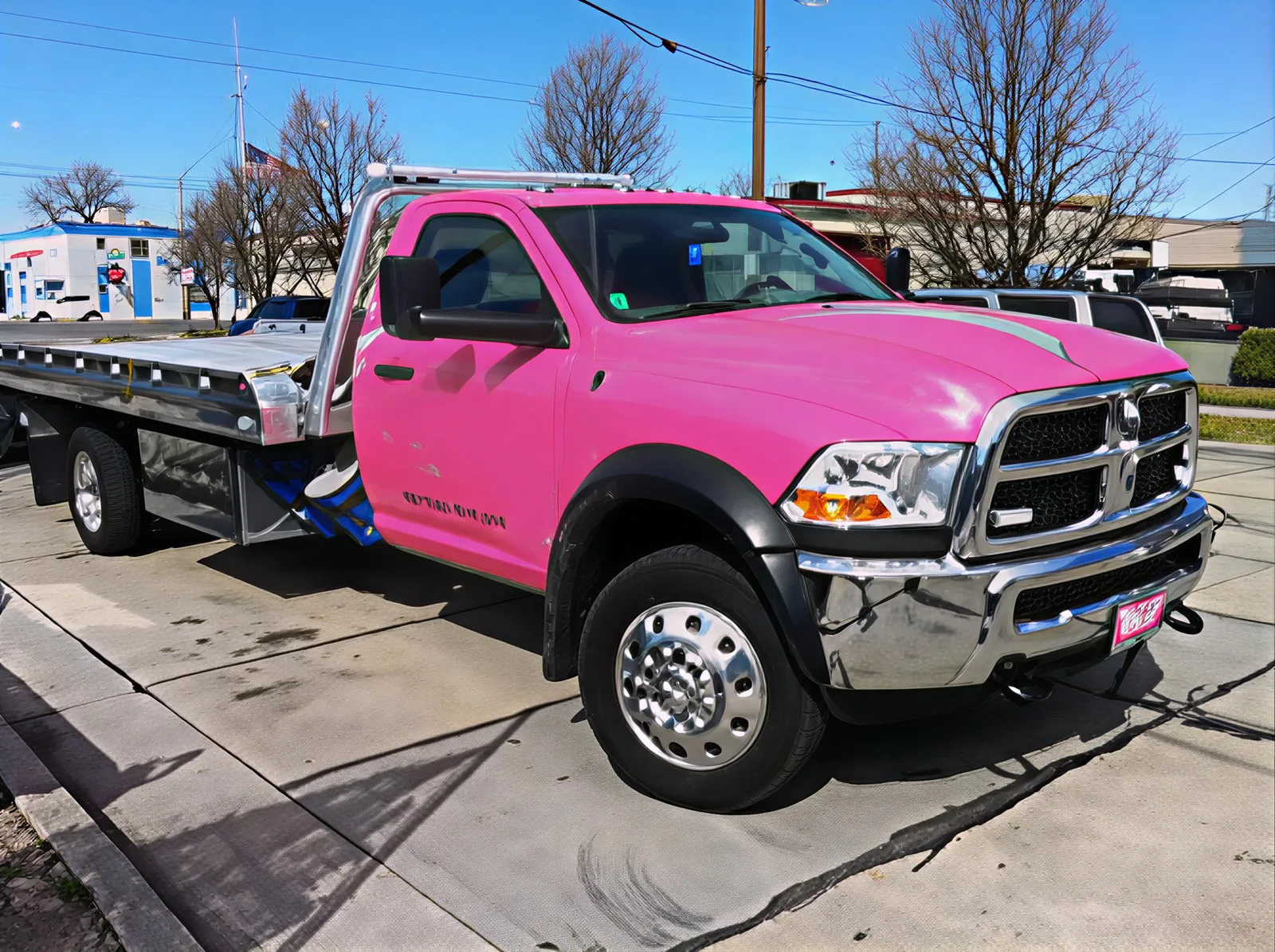
Prefer to write it out? Send dispatch the details with year, make, model, and both addresses. Everything we run on the island is listed on the Merritt Island coverage page, the standing description of this service lives on the light towing page, and the gallery has the pink trucks on real calls.
Dead on Courtenay or stuck in a lot off 520? Say which side you are on.
(321) 728-1869What Island Drivers Ask on the Phone.
If yours is not here, the fastest answer is a human one. Call and ask, day or night.
(321) 728-1869My car died here but I live on the beachside. Can you tow the car and take me too?
I commute to the space center and my shift ends at a fixed time. Can you work around that?
Can you get to me if 520 is backed up toward the beaches?
The car is in a subdivision with a gate. Does that slow things down?
Do you tow to shops on the mainland, or only on the island?
My boat trailer is attached to the car that just died. What happens to it?
Tell Us the Road. We’ll Handle the Bridges.
A live dispatcher takes the location, the destination, and whether you need a seat in the cab. You get the whole price and a time that accounts for whatever the causeways are doing right now.
(321) 728-1869Rather type it out? Send the details to dispatch or see the pink fleet at work.