
Rachel’s Towing & Recovery · 24/7 Dispatch
Boxed In With Six Inches at Each Bumper.
Short blocks, parallel parking on both curbs, and a beach town that fills up every good weekend. Getting the car out of the space is half the job. The deck is the other half.
(321) 728-1869 ask for a price, get one
Indialantic, FL
A Town You Can Walk Across, and a Truck That Cannot.
Indialantic is barely more than a square mile of barrier island, and every dimension in it is small. Blocks are short. Streets run a couple hundred feet before they end at the beach or the river. Parking is parallel, curbside, and by mid-morning on a good weekend there is not an empty space south of the causeway. It is a lovely place to live and a genuinely awkward place to bring a twenty-foot deck.
Most towing problems here are geometry problems. The car itself is usually the easy part. What takes thought is where a flatbed can physically stand while it lays the deck down, because that needs roughly a truck length of straight, level ground behind it, and on a lot of these streets that space is occupied by somebody’s parked sedan.
Getting the Car Out of the Space First.
The classic Fifth Avenue call goes like this. A car will not start, it is parallel parked, and there is a vehicle inches off each bumper. There is no straight line out of that space and no way to line the car up with a deck sitting in traffic behind it.
So the car moves sideways before it moves forward. Skates go under the wheels and the vehicle is walked out of the slot laterally until there is room to bring it around and up onto the bed. It is slower than a curbside pull and it uses far less room, which is the trade you want on a street like that. Two facts decide the whole approach, so have them ready when you call: roughly how much clearance is at each bumper, and whether the wheels still turn.
If the wheels do not turn, or the car is too low to hook, the deck is the answer and we will say so up front.
Rachel’s Towing & RecoveryThe Causeway Landing Is Its Own Situation.
Where the Melbourne Causeway comes down onto the island, the traffic pattern changes fast and there is not much forgiving space. A car that dies at that intersection is in a bad spot, and the difference between a clean load and a messy one is whether the driver knows before he leaves the yard which side of the intersection you are on and whether you are in a live lane or past the curb.
That is why dispatch asks which direction you were traveling and what you can see in front of you. Nobody is making conversation. The answer decides where the truck stages, whether the car gets pulled a short distance to somewhere safer before the deck comes down, and whether this needs to go to the front of the board.
What All Four Wheels Up Is Actually Protecting.
A wheel-lift raises one end of a car and lets it roll on the other two tires. It is a good tool. It is the wrong tool for several common cars, and the reasons are mechanical rather than sales-driven.
All-wheel drive vehicles have the front and rear axles joined through a center differential or a clutch pack. Roll two wheels while the other two are lifted and you are spinning those parts at road speed with the engine off and no oil moving. It rarely fails on the trip. It fails later, expensively.
Beyond that: a lowered car catches its front lip on a wheel-lift’s approach angle, a car with a locked wheel or a bent axle cannot roll at all, and anything with original paint and real history is a car the owner wants strapped by the tires with nothing touching the suspension. The deck answers all four cases identically, and on a run this short the difference in price is minor next to the difference in risk.
What decides whether it rides the deck
- Whether the wheels turn freely, or the car is locked up.
- Ground clearance, and whether it has been lowered.
- All-wheel drive, which usually rules a wheel-lift out.
- Where it is parked, and how much room the deck has to tilt.
Rear Alleys, Small Lots, and Low Overhangs.
The shops and restaurants along the main strip mostly have rear access, and those alleys vary wildly. Some take a flatbed fine. Others are barely wide enough for a delivery van, with no room to turn around once you are committed. If the truck cannot back in cleanly, the car comes out to the street on the line instead, which is usually faster than three attempts at a nine-point turn.
Parking structures and covered spaces are the other limit. A flatbed does not clear a garage height bar, so a car parked under cover has to be brought out into daylight first. Give dispatch the business name and which side the access is on and that gets worked out before anyone is standing in an alley reconsidering.
Seasonal Reality, Said Out Loud.
On a nice Saturday, traffic across the causeway and around the beach access fills up, and dispatch will give you a realistic window rather than a number that sounds nice on the phone. If your car is somewhere safe and legal, that wait costs patience and nothing else. If it is blocking a lane, a driveway, or a business entrance, say that plainly and the call gets moved up.
What does not vary is the price. Dispatch quotes the run on the call from your vehicle, the pickup spot, and the destination, and that is the number on the invoice. Indialantic is right across the causeway from Melbourne, about as short a run as we make.
Other Trucks for Other Problems.
Plenty of calls here do not need a deck at all. A flat tire, a dead battery outside a restaurant, keys locked inside: that is roadside work, and sending a flatbed would be charging you for capability you never used.
Some go the other way. Anything that has been hit rides on a deck regardless of what it is, and accident towing has its own way of clearing a scene. If you are stranded right now instead of arranging a move, emergency dispatch is the faster route. A bike gets motorcycle transport, which uses a chock and a strap pattern that has nothing in common with tying down a car.
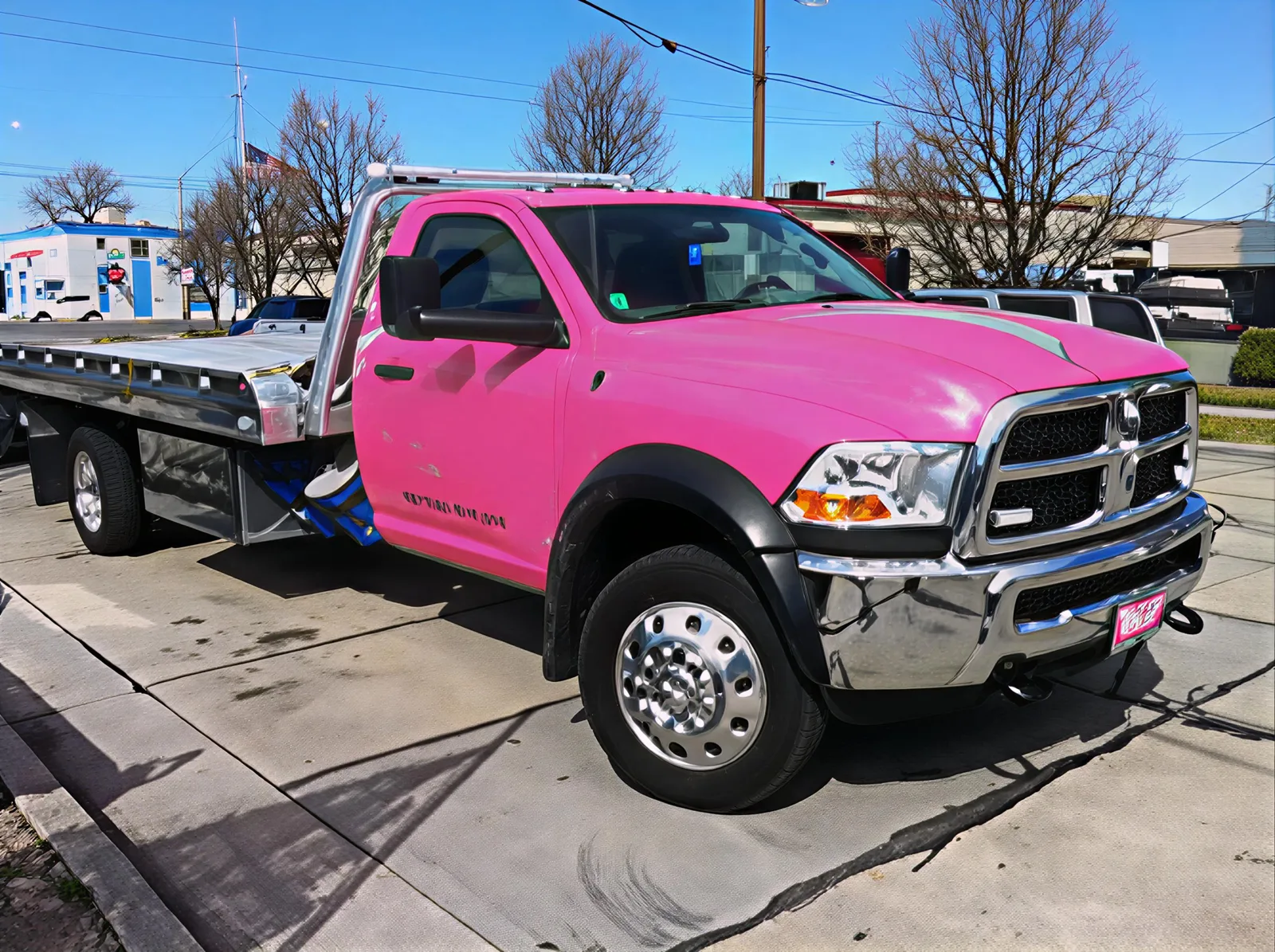
If typing is easier, send dispatch the details with the year, make, model, and both addresses. Everything we run on this end of the island is on the Indialantic coverage page, the standing service description sits on the flatbed towing page, and the gallery shows the pink decks at work.
Parked in tight or stopped at the causeway landing? Tell dispatch which.
(321) 728-1869Short Blocks Raise Specific Questions.
If the one you have is not answered below, call and ask. Somebody is on the line at every hour.
(321) 728-1869My car is parallel parked on Fifth Avenue with cars tight front and back. Can it still be loaded?
The car died right at the bottom of the causeway. Where does the truck stage?
Why can my all-wheel drive car not go on the cheaper truck?
Is a lowered car a problem to load?
It is a summer weekend and the beachside is packed. Does that slow you down?
Do I know the price before the truck comes out?
Can you pick a car up from a small lot behind a shop or restaurant?
Describe the Space. We Will Solve the Rest.
A live dispatcher settles the price before a truck moves, then sends a pink flatbed with the skates and boards it takes to work a street this narrow.
(321) 728-1869Rather type it out? Send the details to dispatch or see the pink fleet at work.