
Rachel’s Towing & Recovery · 24/7 Dispatch
The Deck Comes Down Where There Is No Room.
Short ramps at Barnes and Fiske, driveways under old oaks off the river road, and all-wheel drive that has no business being dragged anywhere. Tight loads are most of what we do on this side of Rockledge.
(321) 728-1869 one call, straight answers
Rockledge, FL
Loading a Car Is Easy. Finding Somewhere to Do It Is Not.
Rockledge is about two miles wide in most places, pinched between the Indian River on one side and I-95 on the other. Everything here happens in a narrow band, and that geography shows up in our work more than the vehicles themselves do. A flatbed needs roughly a truck length of straight, level ground behind it to drop the deck and pull a car up cleanly.
The I-95 ramps are the sharpest version of the problem. Barnes Boulevard and Fiske Boulevard both have short entries with merge lanes that fill fast, and a car that quits partway up one is sitting in the worst possible place: too far along to roll back, not far enough to reach a shoulder that could hold a truck. When dispatch asks which ramp and which direction, that is not small talk. It decides whether the driver stages ahead of you or behind you, and whether the car needs to be moved a short distance to a safer spot before the deck goes down at all.
Old Driveways, Old Oaks, and Cars That Have Not Moved in Years.
Head toward the river and the streets change character entirely. The older Rockledge neighborhoods along and off Rockledge Drive were laid out when cars were narrower and nobody imagined a tow truck with a twenty-foot bed. Driveways curve, oaks lean over them, and the apron where the concrete meets the street is often steep enough to scrape a low car on the way in.
Most of the time the truck never enters the driveway. It parks at the street and the car comes out to it, which needs far less room than backing a flatbed between two trees and hoping the mirrors survive. If the car cannot roll, skates go under it. If the apron is sharp, boards go down so the deck edge does not gouge the pavement or the car’s underside.
A fair number of these calls are vehicles that have not moved in a very long time. A project car under a cover. A parent’s sedan after an estate settles. Something that got parked with a bad transmission in 2019 and stayed. Flat-spotted tires, seized brakes, and bearings rusted solid are all normal on those jobs, and none of them stop the load. They just change the plan, which is why dispatch asks how long it has sat and whether the tires still hold air.
If the wheels do not turn, or the car is too low to hook, the deck is the answer and we will say so up front.
Rachel’s Towing & RecoveryWhy Wheels-Up Is Not an Upsell Here.
People sometimes assume the flatbed is the expensive option being pushed. Worth knowing what the deck actually buys you. In an all-wheel drive vehicle the front and rear axles are joined through a center differential or a clutch pack, so lifting one end and rolling the other spins internal parts at road speed with the engine off and nothing pumping oil to them. Short trips can get away with it. The failure, when it comes, costs more than every tow you will ever pay for.
The same logic covers the other cases. A car with a bent axle or a locked wheel cannot roll at all, so there is nothing to lift onto a wheel-lift in the first place. A lowered car will have its front lip torn off by a wheel-lift’s approach geometry long before it reaches the highway. Anything with original paint and a long history is a car where the owner would rather nothing touched the suspension, and tire straps around the wheels handle that.
On a Rockledge run, the distance is short enough that the price gap between equipment types is small anyway. The gap in what can go wrong is not small at all.
What Gets Asked on the Call, and Why Each Question Matters.
Dispatch will want four things, and none of them are stalling. What you drive, because all-wheel drive, ride height, and weight pick the truck. Where exactly you are, because a ramp, a driveway, and a strip center behind Barton Boulevard are three different setups. What happened, because a car that will not start loads differently from a car with a wheel that will not turn. And where it is going, because a shop that closes at five changes the sequencing.
You get a price on that call, before the truck leaves the yard, and the number holds. Rockledge sits a short run north of Melbourne and a slightly longer one from Palm Bay, which generally works in your favor on both timing and cost.
What decides whether it rides the deck
- Whether the wheels turn freely, or the car is locked up.
- Ground clearance, and whether it has been lowered.
- All-wheel drive, which usually rules a wheel-lift out.
- Where it is parked, and how much room the deck has to tilt.
When Something Else Is the Right Truck.
Not every Rockledge call needs a deck. A dead battery in the Publix lot, a flat on Fiske, or keys locked in the car are roadside work, and sending a flatbed for any of them would be charging you for equipment that does nothing extra.
Other calls are the reverse. Anything that has hit something goes on the deck regardless of what it is, and accident towing runs its own board with its own approach to clearing a scene. If you are stranded right now rather than scheduling a move, emergency dispatch handles it. Past the weight of a heavy pickup the job moves to the heavy fleet, and motorcycle transport uses a chock and a strap pattern that has nothing in common with how a car is tied down.
If typing is easier than talking, send dispatch the details with the year, make, model, and both addresses. Everything we run in this part of the county is laid out on the Rockledge coverage page, the standing description of the service sits on the flatbed towing page, and the gallery shows the trucks and the decks doing exactly this.
Stuck on a short ramp or boxed into a driveway? Tell dispatch which.
(321) 728-1869Asked Between the River and the Interstate.
If yours is not here, the fastest answer is a human one. Call and ask, day or night.
(321) 728-1869There is barely any shoulder on the Barnes Boulevard ramp. Can a flatbed even load there?
My driveway off Rockledge Drive is narrow and there are trees. Will the truck fit?
Why does my all-wheel drive car need the flatbed instead of the cheaper truck?
The car has been parked in the yard for years and the wheels are locked. Still possible?
Do you quote before the truck rolls?
Can a Rockledge shop or storage lot set up an account?
Describe the Spot. We’ll Bring What Fits.
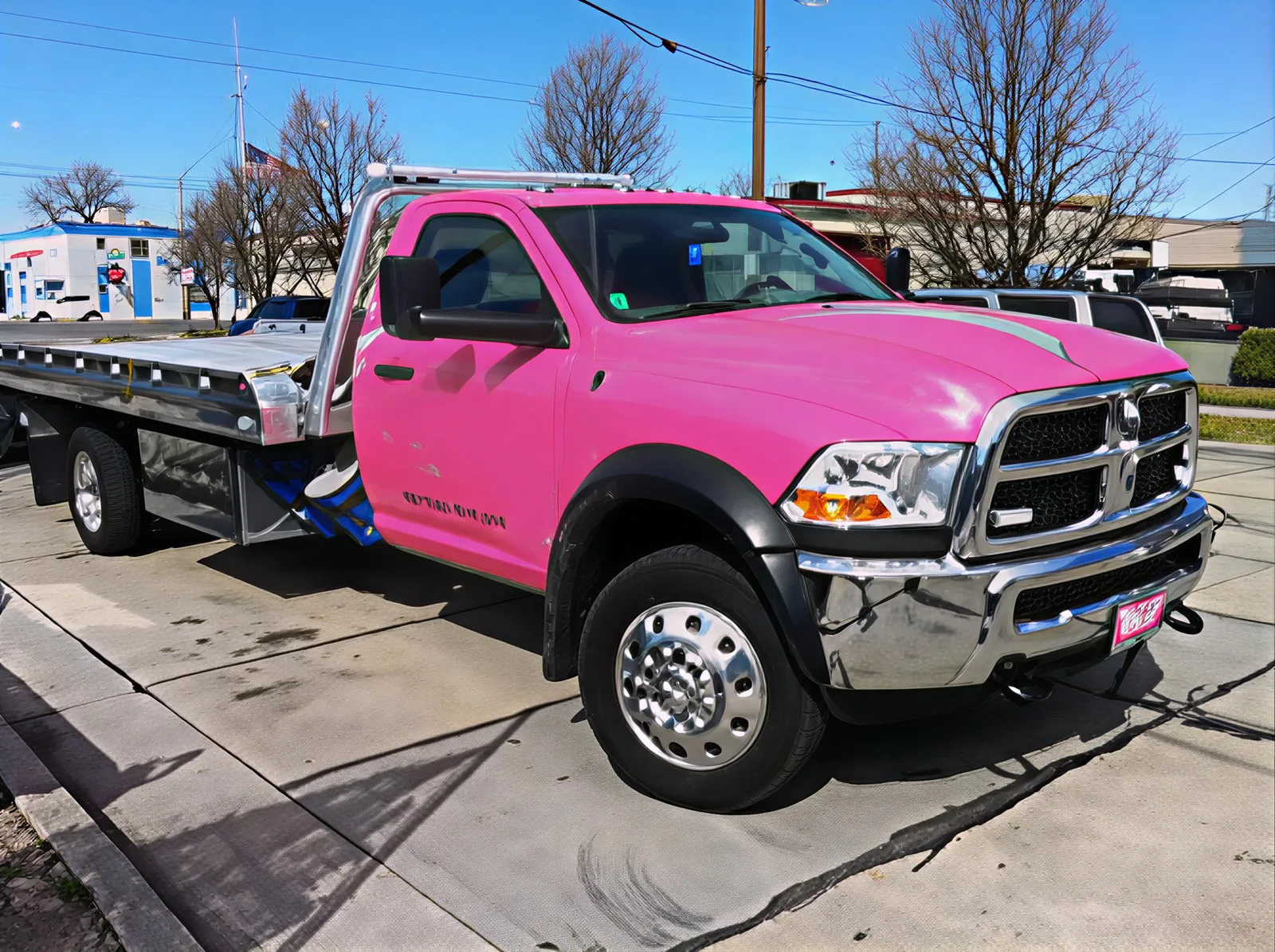
One call reaches a live dispatcher who settles the price before anything moves and sends a pink flatbed built to load where there is no room to work.
(321) 728-1869Rather type it out? Send the details to dispatch or see the pink fleet at work.