
Rachel’s Towing & Recovery · 24/7 Dispatch
Four Tires on the Deck, Nothing Dragging.
Village side streets with brick under the tires and oak limbs overhead. The 520 run out to the beaches. Exit 201 in both directions. When a car cannot be pulled on two wheels, this is the truck that comes.
(321) 728-1869 a real person picks up
Cocoa, FL
Two Towns Share One Name Here, and They Load Nothing Alike.
There is the Cocoa that runs along US 1 and Clearlake Road, full of repair shops, tire places, parts stores, and wide asphalt where a flatbed can drop its deck without a second thought. Then there is Cocoa Village, six or seven blocks of brick pavers, angle parking, one-way turns, and live oaks that hang low enough to brush the top of a raised bed. Both of those are Cocoa. A driver who treats them the same is going to have a bad afternoon in one of them.
That split is the honest reason our dispatcher asks where exactly you are before anything else. On Clearlake the answer is straightforward, back in, tilt, winch, go. On Delannoy or Brevard Avenue in the Village, the truck usually never enters the block at all. It stages on a wider cross street and the car comes out to it under winch line or under its own roll. That takes a couple of extra minutes and saves everybody a bent mirror and an argument about a scraped bumper.
The 520 Corridor Is Its Own Kind of Call.
State Road 520 is the artery from the mainland out to Merritt Island and the beaches, and it is busy in a way that changes what a tow looks like. Cars fail on it constantly, usually mid-corridor with no shoulder worth the name and a line of traffic behind them that is already annoyed. Vacation traffic, cruise traffic, and everybody heading to the water on a Saturday all funnel through the same lanes.
A flatbed on 520 has to be positioned deliberately. The driver picks his stopping point coming in, sets his lights well back, and works from the side of the vehicle away from moving traffic. If the car can be nudged another fifty yards to a driveway apron or a lot entrance before the deck goes down, that is usually the better plan and the driver will say so. When you call, tell dispatch which side of the river you are on and which direction you were going. Those two facts change the whole approach.
Straps in the right places, a level deck, and nothing touching the pavement. That is the whole job.
Rachel’s Towing & RecoveryInterstate 95 at Exit 201, Where the Ramps Get Interesting.
Exit 201 is where 520 meets the interstate, and it produces a steady share of our Cocoa work. The tourist stretch of the ramps means a lot of the cars are not local. Rental SUVs with all-wheel drive. People running down from Orlando for the day. Somebody’s leased crossover that threw a warning light forty miles from their hotel and two hundred from home.
Those are almost always flatbed jobs on the equipment side, because a modern all-wheel drive vehicle should not be dragged on two wheels regardless of how short the trip is. They also tend to be the calls where the driver is most rattled, because they do not know the roads, do not know where the shops are, and have a schedule falling apart. Dispatch can usually name a shop, and if the car is going to sit until Monday, the yard is an option.
Why the Deck Instead of the Cheaper Truck.
A wheel-lift picks up one end of a car and rolls it on the other end. That is fine for a great many vehicles and it is what we bring when it fits. What it will not do safely is any of the following.
- All-wheel drive and full-time four-wheel drive, where both axles are joined and rolling two wheels spins a differential or clutch pack at road speed with no oil moving through it.
- Lowered cars, splitters, and anything with real ground clearance trouble, where the approach angle of a wheel-lift takes the front lip off before the truck ever reaches the road.
- A seized wheel, a locked-up brake, or a bent axle, where the wheels simply will not turn, so there is nothing to roll on.
- Classics, restorations, and anything the owner has poured years into, where straps around the tires beat any contact with the suspension or the body.
None of that is upselling. It is just what the equipment can and cannot do. Ask on the phone which truck your car needs and you will get a straight answer, including the times the answer is that you do not need the deck.
What decides whether it rides the deck
- Whether the wheels turn freely, or the car is locked up.
- Ground clearance, and whether it has been lowered.
- All-wheel drive, which usually rules a wheel-lift out.
- Where it is parked, and how much room the deck has to tilt.
Shop to Shop, Lot to Lot, and the Cars That Have Sat.
A good share of Cocoa flatbed work is not roadside at all. It is a car moving from one shop to another because the first place could not get the part. It is a dealership trade that needs to go across town. It is a vehicle that has been parked behind a building since the owner stopped driving, with tires flat on one side and brakes rusted to the drums.
Long-parked cars are ordinary work here. Skates go under the corners that will not roll, boards go down if the ground is soft or the apron is steep, and the car comes up the deck instead of being dragged across grass. What dispatch wants to know is how long it has been sitting, whether the tires hold air, whether it steers, and whether anybody has a key. Those four answers decide what rides on the truck when it leaves the yard.
Getting a Number Before Anything Moves.
You get a price on the phone, from a person, before the truck is dispatched. That covers your vehicle, the pickup, and the destination, and it is the number that shows up on the invoice. Nobody calls you back later with a surprise, and nobody quotes you at the curb after the car is already strapped down.
Cocoa is a short run north for us, which usually works in your favor on both the wait and the price. If the situation is urgent rather than scheduled, say so first thing and the call gets handled as emergency dispatch instead. If the car will not start but rolls fine and nothing about it is unusual, light-duty towing is the cheaper and correct answer. A flat, a dead battery, or keys shut inside is roadside work and does not need a deck at all.
Anything that has been in a collision goes on the deck no matter what it is, and accident towing handles clearing the scene as well as the vehicle. Past the weight of a heavy pickup the job moves to the heavy fleet. Bikes get a chock and a strap pattern of their own under motorcycle towing.
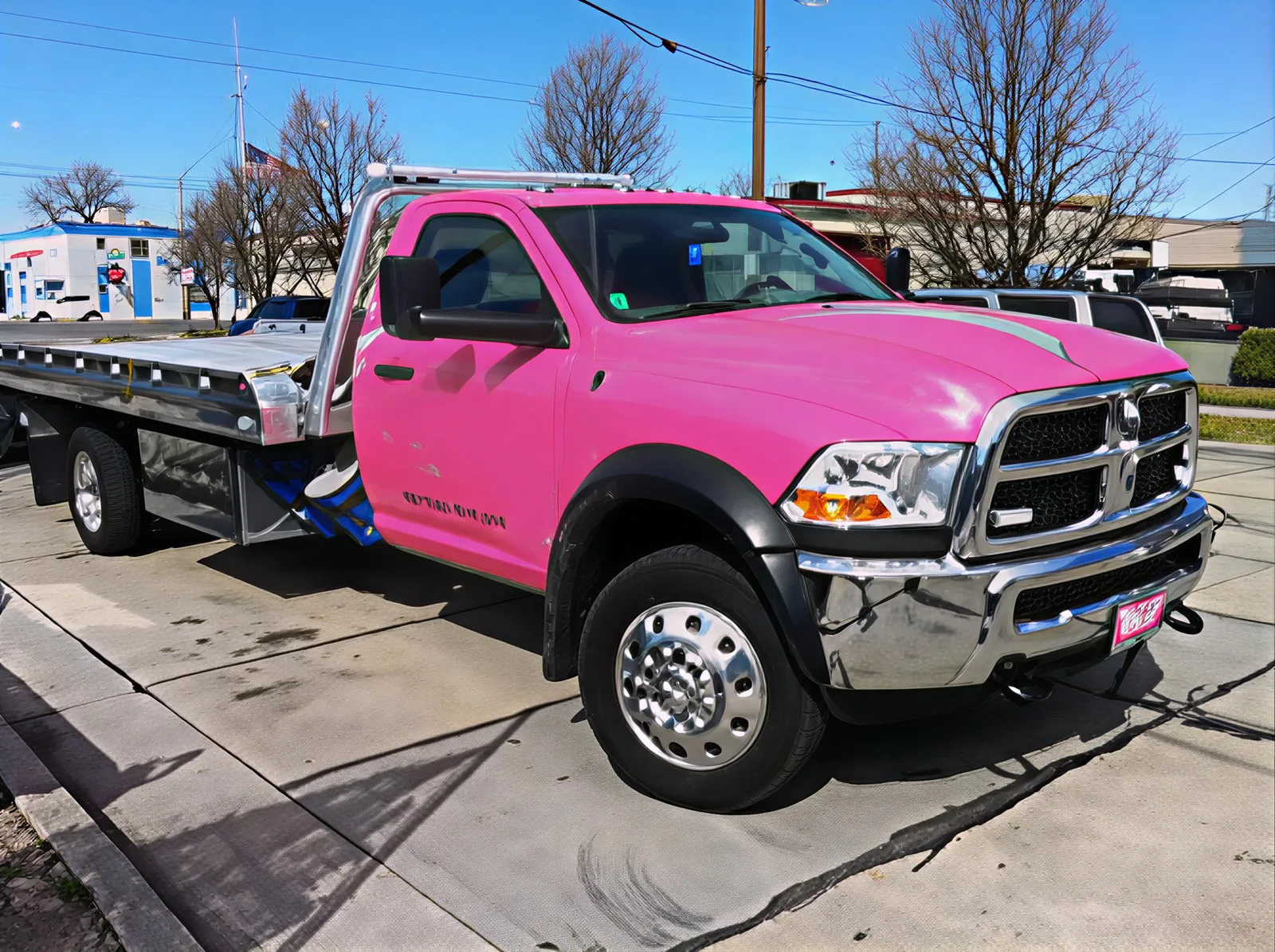
If typing beats talking, send dispatch the details with the year, make, model, and both addresses. Everything we run on this side of the county is listed on the Cocoa coverage page, the standing writeup of the service lives on the flatbed towing page, and the gallery shows the pink decks doing exactly this work.
Village block, 520 shoulder, or the exit 201 ramp? Tell dispatch which.
(321) 728-1869What Cocoa Drivers Actually Ask Us.
If your question is not on the list, the fastest answer is a human one. Call and ask, any hour.
(321) 728-1869The car died in Cocoa Village and the street is brick and one lane. Can you get to it?
My car broke down on the 520 causeway heading to the beach. Is that a flatbed job?
Why can a wheel-lift not tow my all-wheel drive crossover?
I need the car moved between two shops on US 1, not rescued. Do you do that?
Do I get a price before the truck leaves?
The car has not run since before the last hurricane season. Can it still go on the deck?
Say Where It Is. We’ll Send What Fits.
One call reaches a live dispatcher who settles the price before the truck moves, then puts a pink flatbed on the road built to load in places other trucks will not go.
(321) 728-1869Rather type it out? Send the details to dispatch or see the pink fleet at work.