
Rachel’s Towing & Recovery · 24/7 Dispatch
The Ocean Is Two Blocks Away, and Your Battery Knows It.
Salt gets into everything out here. Terminals, connectors, the alternator you replaced four summers ago. When the daily driver quits in the driveway or in a lot off A1A, one call gets a live person, a real time, and the whole price before a truck leaves the yard.
(321) 728-1869 a person picks up, every hour
Satellite Beach, FL
A Town of Cars That Stay a Long Time.
Satellite Beach keeps its vehicles. Drive the residential streets between A1A and the river on a weekday and you see it: sedans with a decade of sun on the roof, an SUV that has hauled the same beach chairs since the kids were small, a second car that mostly sits under a carport waiting for someone to need it. People here buy a car and keep it, because the town is small, the commutes are short, and nothing about daily life demands anything newer.
That habit is fine right up until the morning it is not. Short trips never fully charge a battery. A vehicle that sits three weeks between uses loses ground every single day it sits. Add air that carries salt a few blocks inland and you get a specific local pattern: cars that are mechanically sound underneath but electrically unreliable on the surface.
So a large share of what we tow out of this town is not dramatic. It is a car in its own driveway, on a morning somebody actually needed it, refusing to do the one thing it has always done.
Salt Air Gets a Vote in How Your Car Dies.
Nobody who lives within sight of the ocean needs convincing that salt is corrosive. What surprises people is where it shows up first.
Battery terminals fuzz over faster here. A connection that looks fine can be doing half its job, which means the starter turns slowly, then one day not at all. Owners often replace a perfectly good battery because the real problem was two inches away at the clamp.
Alternators live shorter lives near the beach than they do out west of I-95. When one quits, the car runs on stored charge until it does not, and the classic version of that call goes like this: the car got jumped at nine in the morning, drove fine, then died in a lot near DeSoto Pkwy at four in the afternoon with a driver who thought the problem was handled. A jump on a bad alternator buys minutes, not a repair.
Starters go the same way, usually with a warning nobody heeds. Two turns of the key one week, one slow crank the next, a single click after that. Fuel pumps and ignition switches round out the list. And the biggest category of all is the one with no diagnosis at all: it will not start, we do not know why, please come get it. That call is welcome. Sorting out the cause is a mechanic’s job. The ride is ours.
Most of what we do is not dramatic. It is a dead battery in a driveway and somebody who needs to get to work.
Rachel’s Towing & RecoveryShort Streets, Narrow Driveways, and Low Branches.
Towing on the barrier island is a spatial problem more than a mechanical one. The residential grid was laid out generously for 1960s cars and has been growing landscaping ever since. Driveways meet the street at odd angles. Sea grape and palm hang lower than they look. Some blocks have parking on both sides that leaves a truck exactly one lane to work with.
None of that is a real obstacle when the driver knows before he arrives. Tell dispatch if your driveway is tight, if there is a low canopy over the entrance, if the car is nose-in against a garage, or if a neighbor’s vehicle narrows the approach. Thirty seconds of description on the phone saves fifteen minutes of maneuvering and keeps the whole thing quiet, which on a street where everyone knows everyone tends to matter more than people admit.
Condo and apartment lots along A1A come with their own quirks: gates, assigned spaces, and a low overhang at the entrance. Say which building and which side, and if there is a code, have it ready.
Base Schedules Do Not Wait for Your Car.
A meaningful piece of this town works at Patrick, and a meaningful piece of that group works hours built around a gate, not a clock. When the car will not start at five in the morning, the problem is not really the car. The problem is that being late is not an option today.
That is why dispatch here is a person at every hour rather than a service that takes a message and passes it along. Early runs are ordinary. So are the reverse situations, where the car dies during a shift and the owner cannot leave to meet a truck. Give dispatch the name and number of whoever will be on site, tell us where the keys are, and the tow proceeds without you.
Say up front where the car needs to end up. A shop, a dealership over the causeway, or your own driveway while a part is on order are all fine destinations, and knowing the answer before we load means one trip instead of two.
Tell dispatch this and it goes faster
- Year, make, and model, plus whether it is running at all.
- Exactly where it sits: driveway, lot, shoulder, or garage.
- What happened right before it quit.
- Where you want it taken, if you already know.
The Whole Price, Said Out Loud on the Phone.
Before a truck leaves the yard, you hear a number for the entire job. Not a starting point, not a range that grows once the car is on the deck. The vehicle, where it sits, and where it is going are all we need to quote it, and if something at the scene turns out to be different from what was described, you hear about that before anything gets hooked up.
Being on the island is not a surcharge. It is a causeway and a stretch of A1A between our yard and your driveway, and that distance is inside the number you already agreed to. The same goes for arrival time. If a truck is already working beachside, you hear a short window. If everything is south in Palm Bay, you hear a longer one, honestly, so you can decide whether to wait at the car or go inside.
When the Job Belongs to a Different Truck.
Plenty of calls that start as tows do not need one. A battery, a lockout, a flat, or a dry tank is roadside work, and paying for a tow truck to do it is buying the wrong visit.
If the vehicle is all-wheel drive, sits very low, or has a wheel that will not turn, flatbed towing covers why the deck matters for those. Anything happening right now on a shoulder with traffic close by is emergency towing. Collisions go through accident and collision towing, motorcycles get the chock and strap treatment on motorcycle towing, and anything past the weight of a heavy pickup goes to the heavy-duty fleet.
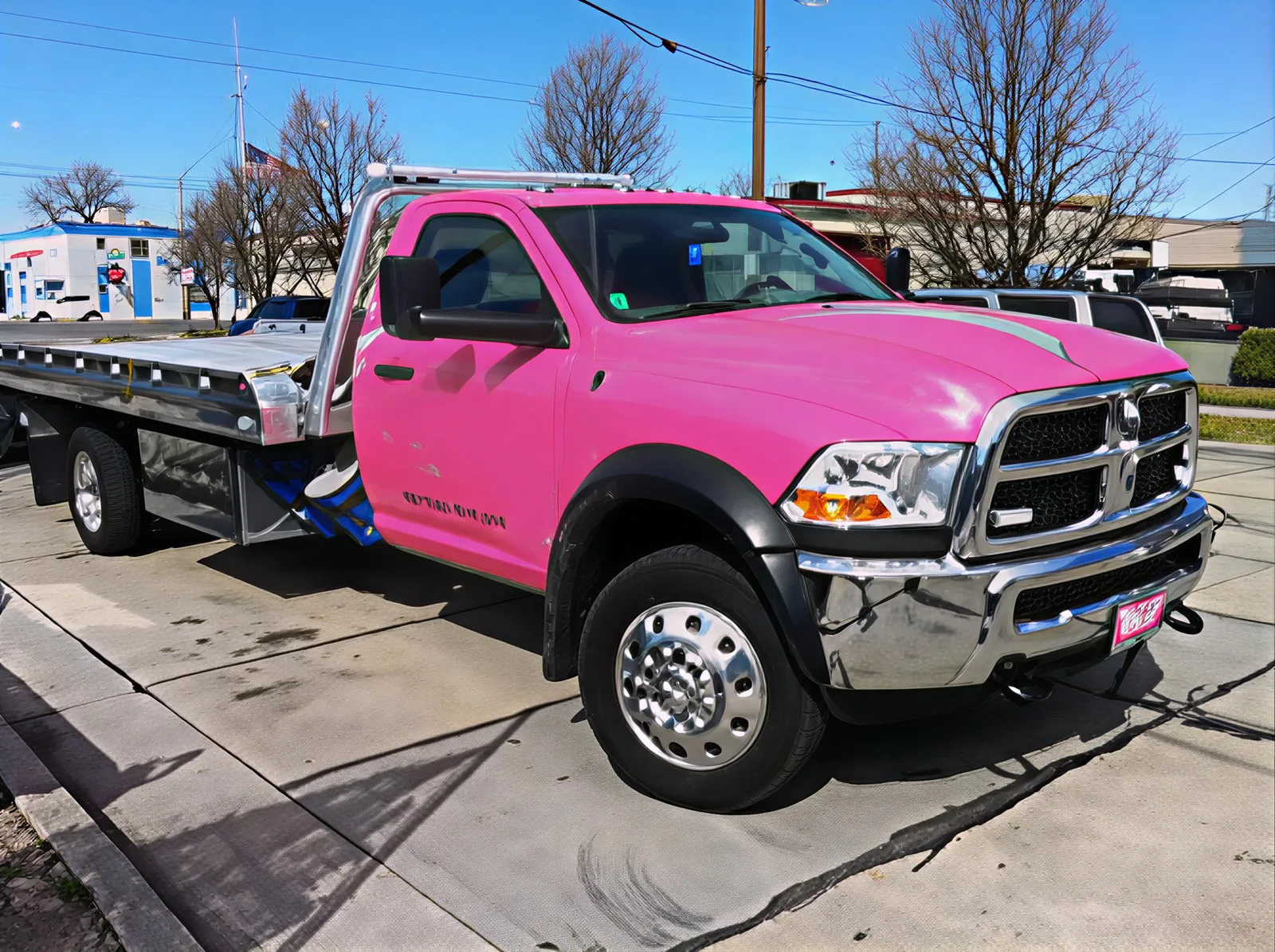
Prefer to write it out instead of talking? Send dispatch the details with year, make, model, and both addresses. Everything we cover on this stretch of the island is on the Satellite Beach coverage page, the standing description of this service lives on the light towing page, and the gallery has the pink trucks on real calls.
Car dead in the driveway or in a lot off A1A? Give us the address.
(321) 728-1869Six Things Islanders Ask Before They Call.
If yours is not here, the fastest answer is a human one. Call and ask, day or night.
(321) 728-1869My car has not moved in three weeks and now it is dead in the driveway. Is that a real tow call?
Can a truck get into my street without taking out a mailbox or a palm?
I have to be on base for a shift. Can someone else meet the truck?
Is a beachside tow priced differently than one on the mainland?
My battery is only two years old. Why does it keep dying here?
How honest is the arrival time you give me?
One Call, One Number, One Pink Truck.
Tell a live dispatcher what you drive, where it sits, and where it needs to go. You get the full price and a real arrival window before anything rolls, and something bright enough to spot from the end of the block.
(321) 728-1869Rather type it out? Send the details to dispatch or see the pink fleet at work.