
Jump, Tire, or Tow: Sorting Out What You Actually Need
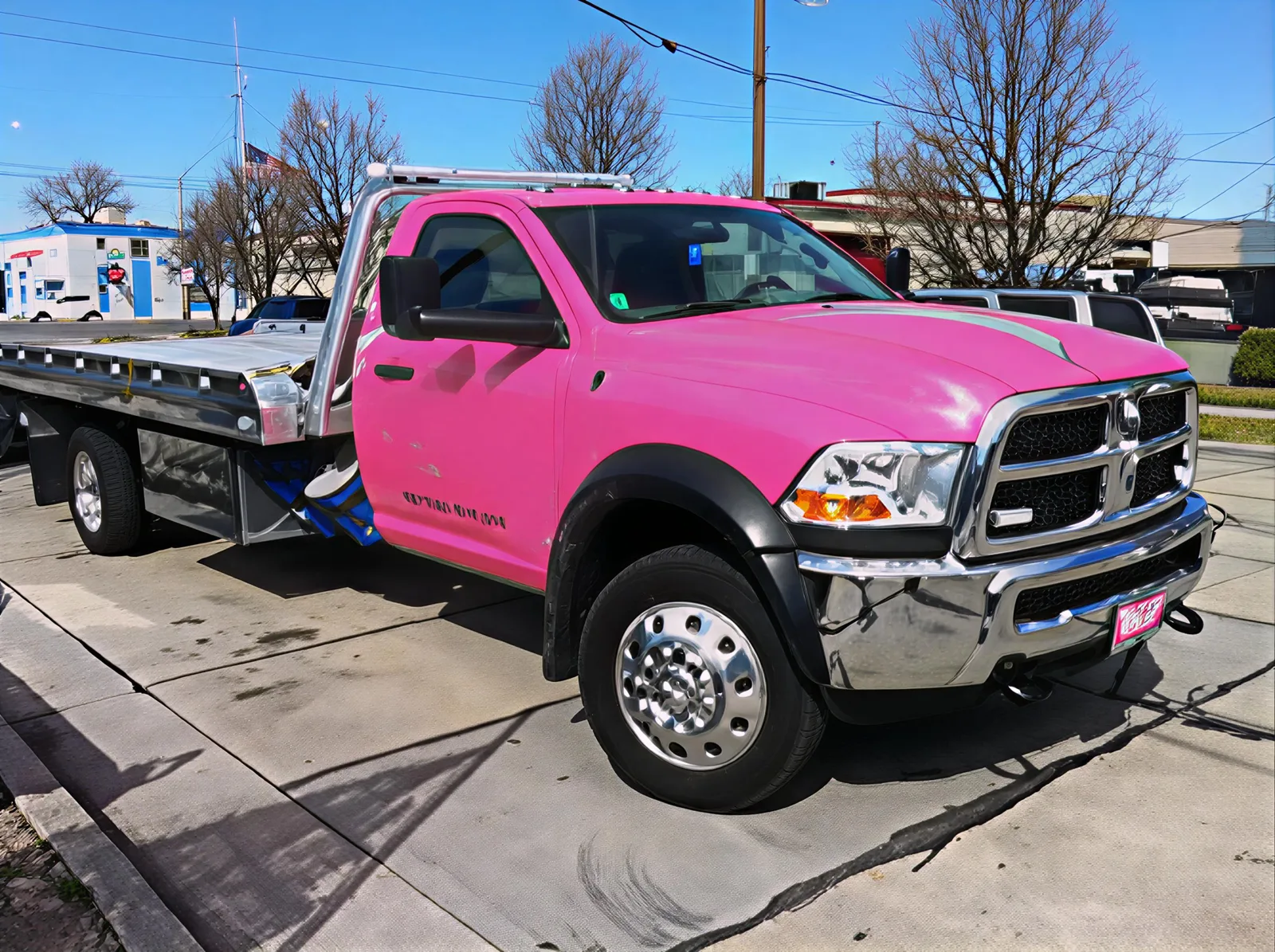
Roadside work fixes one identified thing in one visit: a flat battery, a punctured tire, a locked door, an empty tank. A tow is the right answer when the fault is unknown, when it is mechanical rather than electrical, when the car cannot be safely driven even after the fix, or when where you are sitting makes the repair itself dangerous. The last of those catches more people than the first three combined.
The call we get most often opens with a guess. Somebody has decided what is wrong before describing what happened, and the guess is usually reasonable and occasionally expensive. Our job on that first phone call is to work backward from symptoms to the smallest thing that will actually get you moving.
That is worth being clear about, because we make our living on tows and yet talk people out of them regularly. A tow you did not need is a customer who never calls again, and in a county where our trucks are hot pink and instantly identifiable, that math is not complicated.
The three questions that sort almost every call
Before anything technical, there are three answers that route the call, and you can produce all three from where you are sitting.
First, did the car stop while you were driving it, or did it refuse to start after being parked? That single distinction separates two entirely different families of problem. Something that quits at speed has usually failed mechanically or lost fuel or spark, and those ride in. Something that will not wake up in a parking lot is more often electrical, and electrical is the family roadside work fixes.
Second, do you know what is wrong? Not suspect, know. A visibly flat tire is knowledge. Keys locked in the car is knowledge. A fuel gauge on empty is knowledge. A dashboard full of unfamiliar lights and a strange noise is not, and no amount of roadside equipment substitutes for a diagnosis.
Third, if we fix the obvious thing, is the car safe to drive away? A jumped battery that then dies again three miles down US 1 has not solved anything, it has just moved the breakdown somewhere worse.
When a jump start is genuinely the whole job
Jump territory is narrow and easy to recognize. The dash is dim or dark, the starter clicks rapidly instead of turning the engine, the headlights fade dramatically the moment you try to crank, or the car sat unused for a couple of weeks. Those are the classic signatures of a battery that has run out of the current a starter demands.
The version that needs a follow-up is a battery that has done this before. Twice in a week is the car telling you the battery no longer holds a charge or the charging system is not replacing what you use, and a third jump buries the message instead of answering it. Get both tested the same day at any parts counter. It takes a few minutes and it is the difference between a planned replacement and an unplanned roadside stop.
Where a jump is simply the wrong tool
Skip it if the engine already cranks strongly and just never fires, because strong cranking proves the battery is doing its job. Skip it if you get one heavy clunk while the dash stays bright, which points at the starter. Skip it if the battery case looks swollen or there is crust piled around the terminals, since that is a hazard rather than a repair.
Tire changes, and the spot that decides them
A tire change is the most location-dependent call we run. The work itself is straightforward: get the vehicle level and stable, break the lugs, lift on a rated jack at a manufacturer’s jacking point, swap, torque. It is the ground underneath that turns it into a judgment call.
A firm, level, well-lit surface with room to work is a clean change. A parking lot, a driveway, a side street off Barton Boulevard, a plaza apron. That job takes a fraction of the time a tow would and costs a fraction of what a tow would.
The other kind is a narrow shoulder with traffic passing close at speed. There, changing a tire means kneeling with your body between the car and the lane, on a jack that is only as stable as the surface, while a distracted driver is either going to move over or not. We will still do it if the geometry works, but there are shoulders in this county where the honest recommendation is to put the car on a deck and change the tire somewhere it cannot get anyone hurt.
The problems that are always a tow
Some symptoms end the conversation, and they are worth memorizing so you do not spend an hour discovering them.
Anything to do with the transmission. If the car will not move in gear, moves only in some gears, or shifts with a bang that was not there yesterday, that goes on a truck. Same with a car that will not come out of park, since dragging a locked driveline damages parts nobody wants to pay for.
Overheating is the one people most want to negotiate with. A car that has boiled over needs to be off and cool, and the temptation to run it a few more miles once the gauge drops is how a head gasket becomes an engine. If the temperature gauge went to the top or you saw steam, that car rides.
Then the safety category, which is short and firm: no brakes or a soft pedal, steering that will not track straight, a wheel visibly leaning, anything dragging on the pavement, a strong smell of fuel, or smoke from anywhere. There is also the flood case, which matters here. An engine that stalled in standing water may have drawn water into the intake, and turning the key is how a repair becomes a replacement. Leave it alone and say so on the phone, and it goes on the flatbed for emergency towing in Rockledge without ever being started.
When roadside is technically possible and still the wrong answer
This is the section that saves people real money, and it is the one nobody expects from a towing company.
The first case is time. If a roadside fix is a coin flip and it is late afternoon, a tow that reaches a shop before the service counter closes is worth more than a repair attempt that might work. The difference is driving your own car tomorrow versus renting one for three days, and it is decided by an hour.
The second case is repetition. A car that has needed the same roadside visit twice in a month is not a roadside customer anymore. Each visit is buying a few days and hiding a fault that is getting worse, usually somewhere less convenient than where you are now.
The third case is the spot itself, which loops back to the shoulder. A five-minute job in a parking lot is a genuinely risky job on the edge of a fast road, and the correct move is to change where the car is before changing anything about the car. If you are unsure which of these you are in, describe it out loud and let a dispatcher tell you. Call (321) 728-1869 and you will get a straight answer, including the answer that costs us the bigger job. If it turns out to be the small fix, roadside assistance in Rockledge is what rolls, and if you would rather write it out with a photo attached, send the details to dispatch instead.
The questions that come up on this call
Can you tell me over the phone which one I need?
Usually, and that is the point of the call. Describe what the car did rather than what you think broke: the sound, whether it happened while driving or while parked, and what the dashboard is doing. A dispatcher can narrow it down before a truck leaves the yard most of the time.
What if the jump works and the car dies again a mile later?
Then the charging system is the fault, not the battery, and the car needs to go to a shop. An engine that runs for a few minutes after a successful jump and then quits is running on stored charge alone, which is the clearest signal an alternator gives you.
I have a spare but no idea how to use it. Is that a roadside call?
Yes, and it is a common one. There is nothing embarrassing about it. Tell dispatch where the car is parked and whether the surface is level, and the driver brings a rated jack rather than relying on whatever came in the trunk.
Does an all-wheel-drive car change the answer?
It changes the tow, not the triage. All-wheel drive goes on a flatbed with every wheel off the ground, because dragging driven wheels risks the driveline. If the fix is roadside, it makes no difference at all.
Not sure which one you need?
Describe what the car did and where it is sitting. We will name the smallest thing that fixes it, even when that is not a tow.
More posts · Rockledge services · Send the details to dispatch