
Taking a Travel Trailer to Storage or the Shop Without Your Own Truck
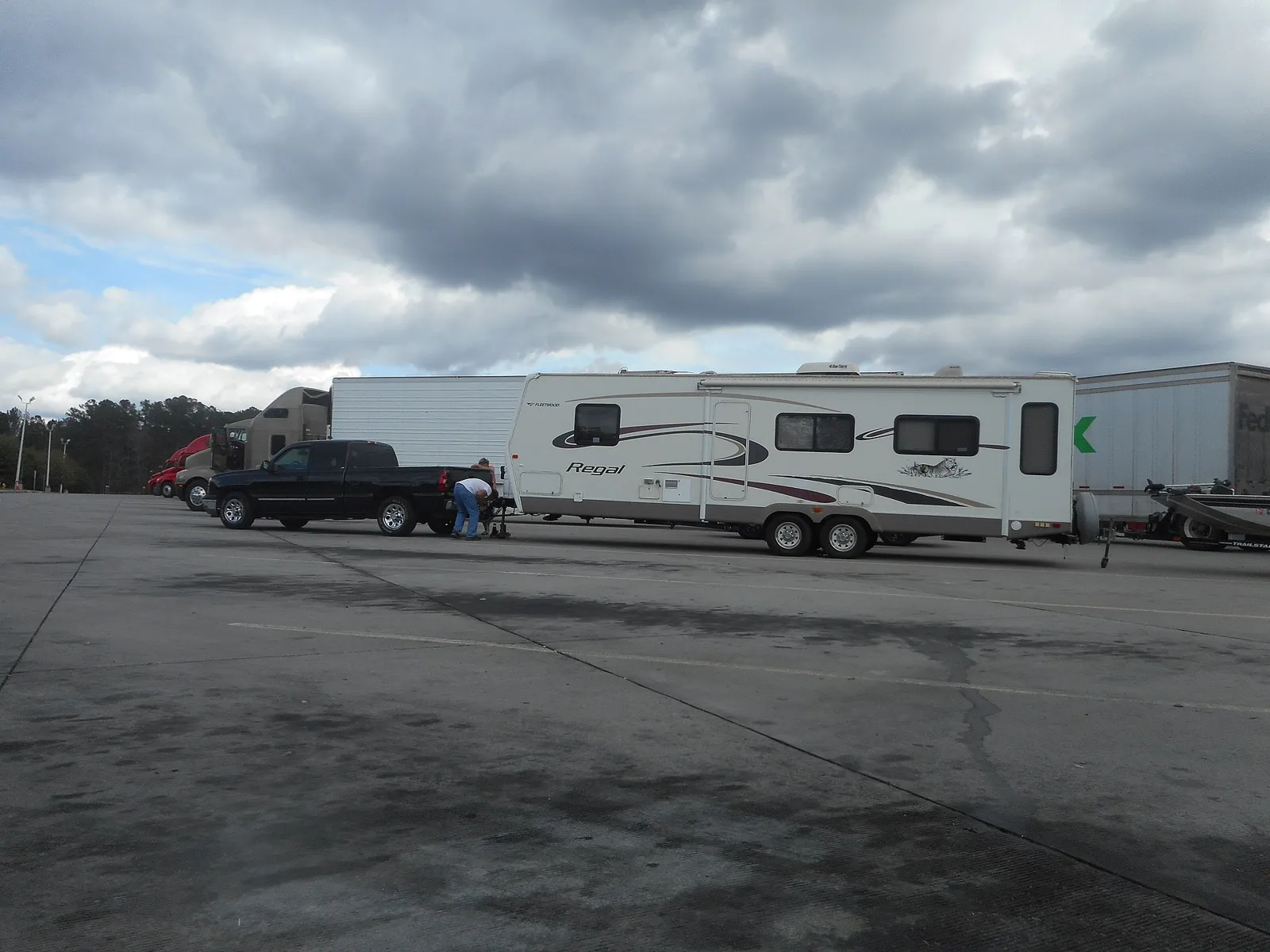
A bumper-pull travel trailer headed for storage or a service shop can ride behind our truck when yours is not rated for it, is in the shop itself, or is gone for good. Before the booking, get the slides in, the stabilizer jacks up, the awning stowed, the propane closed and the fridge latched. Dispatch then needs the length, the axles, the sticker weight and the hitch details.
Plenty of travel trailers outlive the truck they were bought with. Others came along with a house, or the family pickup got traded for something that struggles with a utility trailer. Either way, the trailer still has to go places: into storage, to a service shop for a roof check or new bearings, or to whoever bought it.
None of that requires buying a truck you will use twice a year. It requires a little prep and a phone call.
When your own truck is the wrong tow vehicle
Every pickup carries a towing rating, and a loaded travel trailer can pass it by more than owners expect. The weight on the sticker is the empty weight. Fresh water, propane, batteries, dishes and a garage full of camping gear all pile on top. A half-ton truck that handled the trailer fine when it was new may be working much harder now that it hauls a few seasons of stuff.
Then there are trucks that simply are not available: in the shop, sold, or needed for work all week. Motorhomes and RVs are part of what our trucks bring out of Orlando already, and a bumper-pull trailer is the hitch side of that same work.
A fifth wheel hooks up differently and needs a different setup in the truck bed. If that is what you own, our fifth-wheel towing page covers how those moves work.
Getting the trailer ready to roll
Prep happens before the truck pulls up, and most of it matches the routine you already run before a trip. Bring every slide all the way in. Raise the stabilizer jacks fully. Roll the awning up and make sure its arms are latched, because an awning that unrolls at speed tears itself apart along with whatever it hits.
Inside, close the propane at the tank, latch the fridge and every cabinet, shut the roof vents, and set loose items on the floor. Unplug the shore power cord and the water hose, and coil them somewhere they cannot slide around.
Take a look at the tires while you are outside. A trailer that sat parked all summer can lose pressure and crack along the sidewalls, and the shop visit you are booking may be the right moment to replace them. Air them to the number on the sidewall or the door sticker, and mention any tire that will not hold.
Check the breakaway cable
Find the breakaway cable at the tongue. It connects to the tow vehicle and sets the trailer brakes if the trailer ever separates. Make sure the cable is intact and that the small battery it relies on holds a charge. The operator clips it on during hookup, along with the safety chains and the light plug.
The details dispatch asks for
Dispatch needs the trailer’s length, how many axles it rides on, and an approximate weight from the sticker, usually found on the outside near the front or inside a cabinet door. Give the hitch type and the ball size printed on the coupler. Say whether the trailer has its own working brakes, and whether the lights come on when it is plugged in.
A trailer with dead brakes or dark lights can still move in many cases, but it changes the plan, and it is far better to hear that on the phone than at the curb with the operator ready to hitch. If you use a weight distribution hitch, mention that too, since the bars and chains come off or go on as part of the job.
The photo above catches the moment that matters most: someone bent over the hitch on a wide concrete lot, checking the connection one more time. Every hookup we do ends with that same check.
Storage lots and service shops have their own rules
Storage yards often keep gate hours, assign spaces, and set rules about how a trailer gets parked. Call ahead and confirm the space number, the gate code, and whether someone on site needs to sign the trailer in. Some lots want the tongue facing a particular direction, and it is easier to know that than to guess.
Service shops run on their own timing. A shop may only take drop-offs on certain mornings, or want the trailer cleared of food and personal items first. Ask what they need and pass it along to dispatch so the drop is planned together with the pickup.
If the trailer sits at a campground site or a friend’s property, describe the way out: tight turns, overhanging trees, soft ground, a neighbor’s camper parked close on one side. Leave the wheel chocks where they are until the operator has the trailer hitched, chained and ready to pull out.
Planned from Palm Bay, with an honest window
The Rachel’s yard sits in Palm Bay, about 71 miles from Orlando. Moving a travel trailer to storage or a shop is a scheduled job, so you get a booking and a window you can count on, with no promise about how fast a truck can appear. A trailer move can be planned days ahead, and that suits this kind of work.
A trailer that has come loose or broken down on the road is another matter. Get people well clear, call 911 if anybody is in danger, and accept that a truck closer to you may be the quicker answer that day.
See how we handle these moves on our travel trailer towing page for Orlando. Call (321) 728-1869 to book, or send the details to dispatch with the sticker weight and a photo of the hitch.
Questions trailer owners ask before a move
Can the trailer move with my belongings inside?
Yes, within reason. Secure everything so nothing shifts, and remember that extra gear adds weight dispatch needs to hear about. Take valuables and anything fragile out with you. If the trailer is headed to a service shop, ask the shop whether they want it emptied before it arrives at their door.
What if a slide will not come in?
Tell dispatch on the call. Many slides have a manual override or a crank, and the owner’s manual shows where to find it. A slide that stays out makes the trailer wider than a lane allows, so the move waits until it is fully in. A dead house battery is often the reason, so check that first.
Can you take it from one storage lot to another?
Yes. Give dispatch both addresses, both gate codes, and the hours at each lot. The trailer stays on our hitch the whole way, so there is no transfer in the middle. Confirm the new space is assigned and empty before booking, so the trailer has somewhere to land when the truck pulls in.
Trailer due at storage or the shop?
Give dispatch the length, the axles, the sticker weight and where it is headed. We book a window and match the hitch.