
Rachel’s Towing & Recovery · 24/7 Dispatch
Half the Cars Out Here Are Not From Here.
Rental sedans with sand past the rocker panels, somebody’s restored coupe two blocks off A1A, and a loaner crossover the renter is not allowed to let anyone drag. All four wheels go on the deck.
(321) 728-1869 a person picks up, day or night
Cocoa Beach, FL
A Barrier Island Full of Cars Nobody Owns.
Cocoa Beach runs about seven miles of sand with one real road down the spine of it. On a busy week a large share of the traffic on A1A belongs to somebody who flew in yesterday: rental compacts from the airport, oversized SUVs booked for a family of six, and the steady bleed of vehicles coming off the cruise terminals up the road. Those cars break down like any others. What is different is the paperwork attached to them, and how few of the people driving them know where anything is.
That changes the first two minutes of the call. Before anything else, dispatch wants to know whether the car is yours or rented, because a rental agreement usually names where the vehicle is allowed to go. If we get that address on the phone, the run is quoted and routed to it directly. Find that out after the car is already loaded and you have paid for one tow and are about to pay for a second.
Sand Is Not a Surface. It Is a Trap With a Nice View.
The beach access ramps catch somebody almost every week. A driver pulls a little too far forward at the end of one of the numbered street ends, the front wheels drop into soft dry sand, and within thirty seconds of trying to reverse the car has dug itself in to the frame. Four-wheel drive makes people braver and does not make sand firmer.
Two things happen on those calls, in order. The car comes out of the sand, then the car goes on the deck. Getting it out is about pull angle more than winch power, and it matters whether the vehicle is sitting level or nose-down toward the water. Once it rolls again, it goes up on the bed rather than back onto the street, because sand packs into brake assemblies and wheel wells and nobody knows yet what else it found. When you call, say which street end you are at, how deep the wheels have gone, and whether the tide is coming in. That last one changes how quickly the truck leaves the yard.
A flatbed is not the fancy option. For a lot of these cars it is the only option that does not add damage.
Rachel’s Towing & RecoveryWhy the Deck, and Not the Cheaper Truck.
A wheel-lift picks up one end of a car and rolls it on the other two tires. Fine for plenty of vehicles. Wrong for a lot of what ends up on this island. All-wheel drive is the big one. The front and rear axles are tied together through a center differential or a clutch pack, so rolling two wheels while the other two are lifted spins internal parts at highway speed with the engine off and nothing circulating oil. Rental fleets are full of AWD crossovers, and the renter is the one who gets billed for that damage months later.
The rest of the list is shorter but just as firm. A lowered car catches its front lip on the approach angle of a wheel-lift before the tow even starts. A car with a bent axle or a wheel that will not turn has nothing to roll on. And the collector cars parked in the garages behind Minutemen Causeway, the ones that come out on nice Sundays, are cars where the owner wants tire straps and a flat deck and absolutely nothing hooked to the suspension. All four wheels up settles every one of those cases the same way.
Narrow Streets, Full Curbs, and the Tourist Calendar.
Off the main road, the side streets here are short and tight, with parking on both curbs from spring break through the fall. A flatbed needs roughly a truck length of straight, level ground behind it to lay the deck down and pull a car up cleanly, and on some of those blocks that space simply does not exist between two parked cars.
The usual answer is that the truck never comes down the lane at all. It sets up on the wider cross street and the car comes out to it on the line, which needs a fraction of the room. If the car is boxed in front and back, the driver works out what can be done before he arrives instead of standing there deciding. Tell dispatch the street, whether both curbs are full, and what time it is. A January morning and a Fourth of July afternoon on the same block are two different jobs.
What decides whether it rides the deck
- Whether the wheels turn freely, or the car is locked up.
- Ground clearance, and whether it has been lowered.
- All-wheel drive, which usually rules a wheel-lift out.
- Where it is parked, and how much room the deck has to tilt.
What Salt Air Does to a Car That Lives Here.
Vehicles kept a few blocks from the surf line corrode on a schedule. Rotors go rusty enough to bind, calipers seize, and the tie-down points underneath a car turn crumbly long before anything looks wrong from the outside. A car that has sat under a carport all season may simply refuse to roll when you push it.
None of that stops a load. Skates go under the dead corners and the car rolls onto the deck instead of being dragged. Straps go around the tires rather than anywhere on a frame rail that salt has been working on for a decade. It is worth telling dispatch how long the car has sat and whether the tires still hold air, because those two facts decide what equipment comes off the truck.
The Price Is Settled Before Anything Moves.
Dispatch quotes the run on the phone using your vehicle, where it sits, and where it is going. That number is the number on the invoice. Nobody re-prices anything at the curb with your car already strapped down, and there is no call center in another state guessing at Brevard geography. One caveat worth saying plainly: on heavy cruise turnaround days, A1A between the port and downtown moves slowly, and dispatch gives you a realistic window instead of a hopeful one.
When a Flatbed Is the Wrong Answer.
Plenty of calls out here do not need a deck at all. A dead battery in a hotel lot, a flat in a public parking space, keys shut inside a rental with the engine running: that is roadside work, and sending a flatbed would mean charging you for equipment that does nothing.
Some calls go the other way. Anything that has hit something goes on a deck no matter what it is, and accident towing runs its own approach to clearing a scene. If you are stranded right now rather than planning a move, emergency dispatch handles it. A bike gets motorcycle transport, which uses a chock and a strap pattern with nothing in common with how a car is tied down.
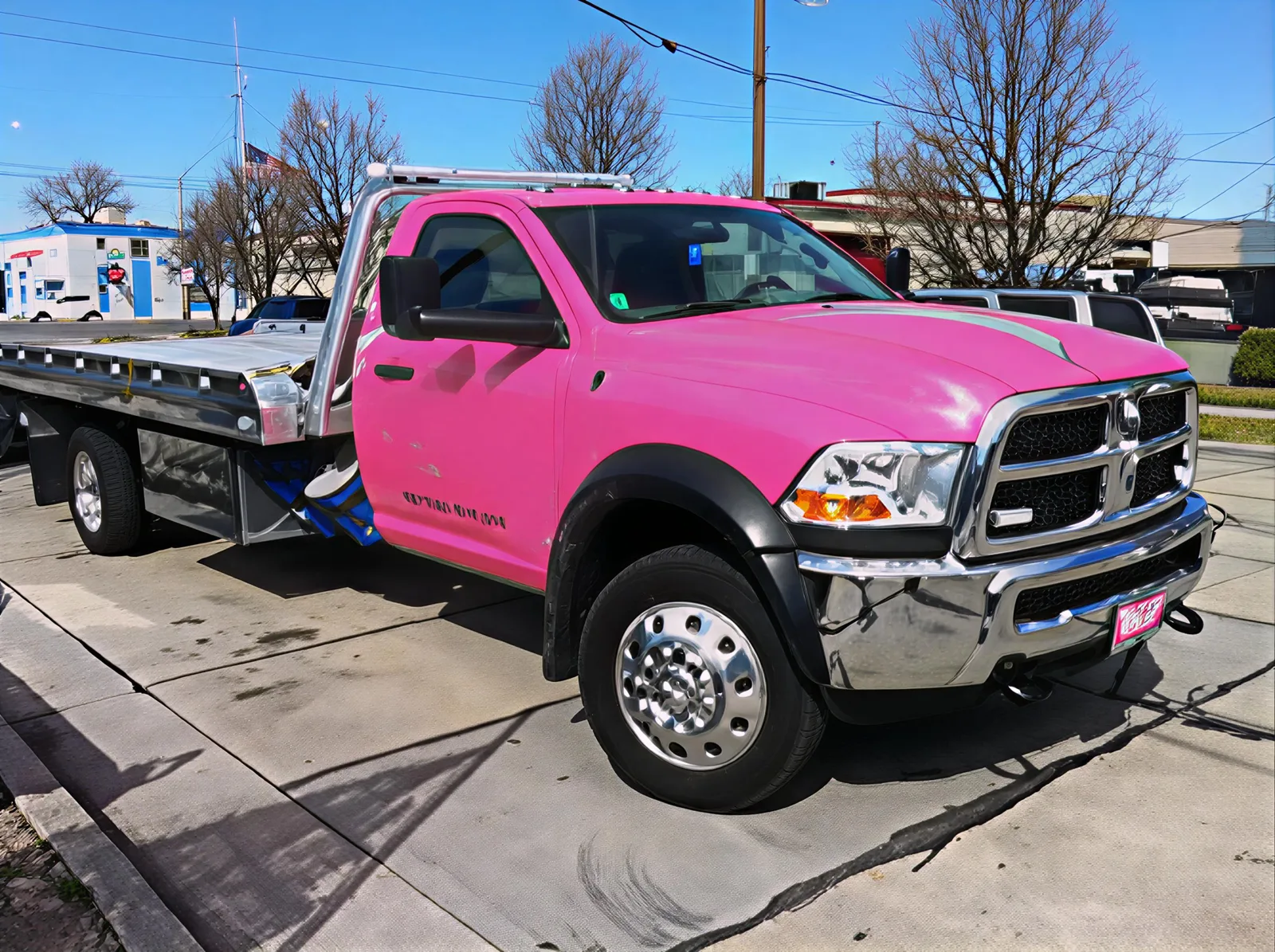
If typing beats talking, send dispatch the details with the year, make, model, and both addresses. Everything we run on this stretch of the island is on the Cocoa Beach coverage page, the standing service description sits on the flatbed towing page, and the gallery shows the pink decks doing exactly this work.
Rental car in the sand or a low car that cannot be dragged? Say which.
(321) 728-1869What Visitors and Locals Both End Up Asking.
If your question is not below, the fastest way to an answer is to ask a person. Call any hour.
(321) 728-1869I buried a rental car in the sand at a beach access ramp. What happens now?
The rental agreement says the car has to go to a specific place. Can you deliver there?
Why does an all-wheel drive rental need a flatbed at all?
My side street off Minutemen Causeway is narrow and cars are parked both sides. Can the truck get in?
Does salt air actually change anything about how the car loads?
Am I told the price before the truck leaves?
Cruise traffic has A1A backed up solid. How does that affect the wait?
Tell Us the Car and Where It Is Sitting.
One call reaches a live dispatcher who prices the run before anything moves, then sends a pink flatbed that puts all four wheels up and leaves the drivetrain alone.
(321) 728-1869Rather type it out? Send the details to dispatch or see the pink fleet at work.