
Rachel’s Towing & Recovery · 24/7 Dispatch
Lowered Vehicle Towing for Port St. John.
A dropped car does not climb a deck the way a stock one does. The front lip hangs lower than the tires can lift it, and one careless pull up a steep ramp costs you a splitter. Tell dispatch how low it sits, and the truck shows up set for that car.
(321) 728-1869 tell us how low it sits
Port St. John, FL
Why a Low Car Scrapes on an Ordinary Deck.
A rollback deck tilts down until its tail meets the pavement, and that tail works like a hinge. The car has to climb from flat ground onto a slope, and the first part of it to meet that slope is whatever hangs lowest ahead of the front wheels. On a stock sedan that is a bumper cover with a few inches to spare. On a car dropped on coilovers or bagged close to the frame, it might be a carbon lip riding a finger’s width off the road.
The name for it is approach angle. Picture a line from the bottom of the front tire up to the lowest point of the nose. If the deck is steeper than that line, the nose touches before the tires ever start to climb. Every lowered car has its own number, and a driver who has never thought about it finds out the expensive way.
Port St. John is mostly neighborhoods, so most of these calls start in a driveway or at a curb at home. That works in your favor. Flat pavement and no passing traffic give the driver room to look, set up and load slowly, which is how a low car should come aboard anyway.
Ramps, Blocking and a Gentler Climb.
The answer is to make the slope shallower than the car’s own approach line. The deck goes down to its lowest tilt. Ramp extensions or wood blocking go at the tail so the front tires start climbing before the nose ever reaches the hinge. On a very low car, the driver may also set boards under the front tires on the ground first, lifting the nose an inch or two before it meets the ramp at all.
None of this is quick, and it should not be. Somebody watches the gap between the lip and the deck the whole way up, from the side, at eye level. If that gap closes, the pull stops, the setup changes and the pull starts over.
The winch comes in slowly and in a straight line. A car pulled at an angle walks sideways up the deck, and sideways is how a side skirt catches the edge of a rail. Straight and slow is tedious to stand and watch. It is also why the car rolls off at the other end looking the way it did when it went on.
Bags, Coilovers and What Dispatch Needs to Hear.
If the car still runs and it has air suspension, raise it to its highest setting before the truck gets there. That one step can turn a fussy load into an ordinary one. If your coilovers adjust and you have the tools and the daylight, the same goes for them, though nobody expects you to wrench on a car in the driveway at night.
When the car will not start, the bags may already be down or sinking slowly. Say so on the phone. A car resting on its bump stops sits lower than it ever does on the road, and the setup has to plan for that height instead of the one in your photos. These are the details worth mentioning when you call:
- A rough guess at the gap under the front lip, even if you have to eyeball it.
- Air ride, a static drop or adjustable coilovers, and whether the car can lift itself right now.
- Anything aftermarket hanging under the front, like a splitter, canards or an intercooler.
- Whether it runs, rolls and steers, or none of the three.
Those answers let the driver bring the right blocking instead of discovering the problem at your curb.
Strapped by the Tires, Nothing Hooked to the Body.
Frame hooks and chains made sense when every car had a thick steel frame with obvious places to grab. A lowered car usually offers neither. The factory tie-down points can hide behind a lip or a diffuser, the suspension arms may be aftermarket pieces nobody wants a chain wrapped around, and the space underneath is too tight to reach into without scraping something.
So the car gets strapped by its wheels. A strap goes over each tire and pulls it down against the deck, which holds the car where it ought to be held, at the rubber. The suspension keeps working the way it does on the road, and nothing metal touches the body.
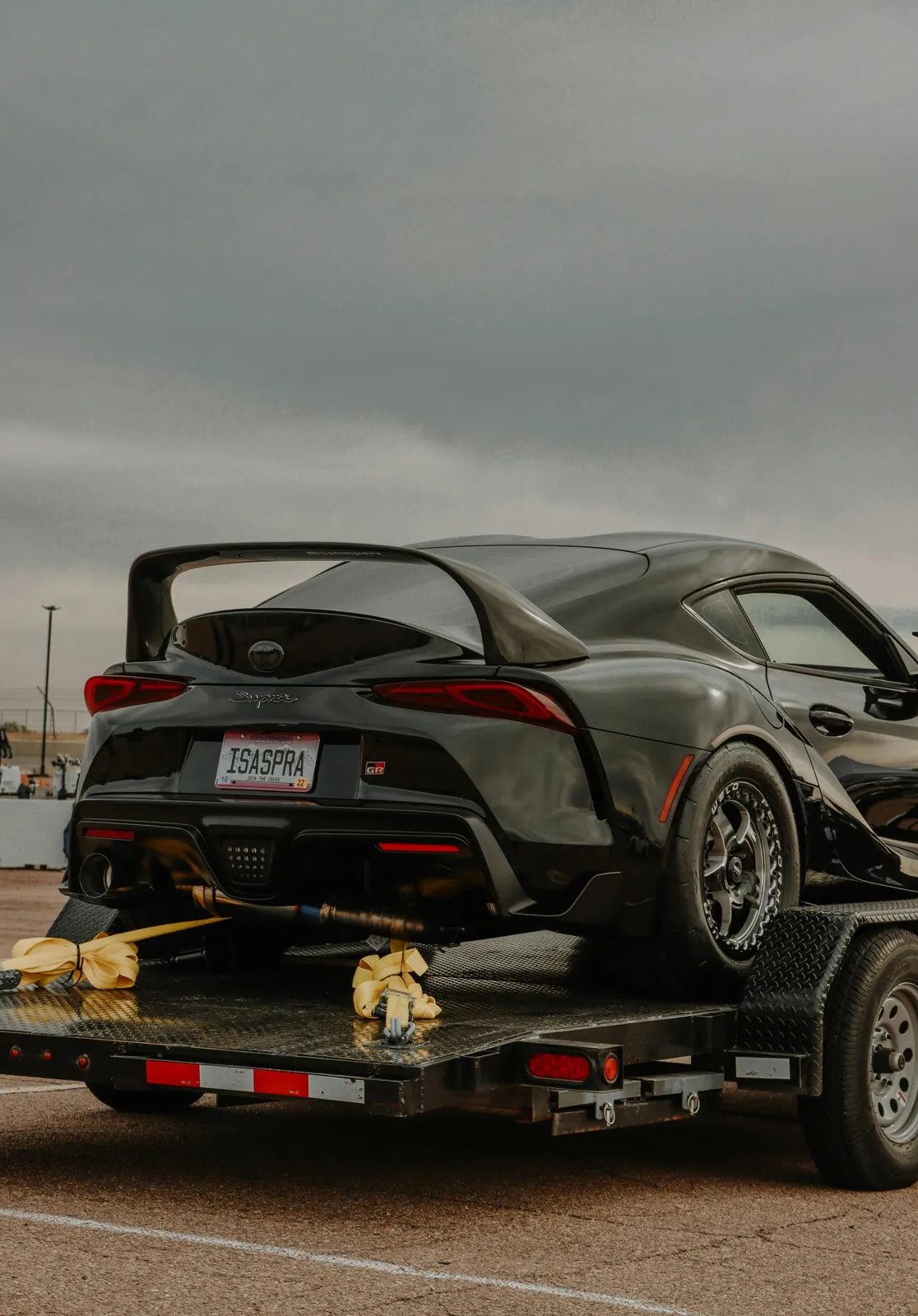
A wheel lift is off the table for most lowered cars. Picking up one end tips the other end toward the pavement, and a dropped car has no room to give at the far bumper.
Steep Aprons, Curb Cuts and the Trip Out of the Driveway.
Loading is half the job. The other half is getting the car to the deck in the first place. A low car that has to come down a steep driveway apron or bump across a curb cut can scrape before the truck is even part of it. If the car runs, please do not drive it out to the street to save time. Leave it where it sits and let the driver look first.
Sometimes the answer is to back the truck in and load right on the driveway. Sometimes it is to ease the car down onto boards at an angle so the low points clear the transition one corner at a time. A car that will not roll gets a slow winch the whole way from where it is parked, and that can mean setting up across the apron before anything else happens.
The drop matters just as much. A shop in Cocoa or Titusville with a steep entrance, or a garage with a raised threshold, needs the same care when the car comes off. Name the destination when you call so the driver can plan both ends of the trip.
Everything Rachel’s covers up here is on the Port St. John page, and the full write-up on lowered vehicle towing applies across Brevard. A car that sat for years on old tires calls for a different kind of patience, so classic car towing has its own page, and a plain short move with nothing hanging low is local towing. If typing is easier right now, write to dispatch with the car and the address. The gallery shows the pink trucks that answer these calls.
Low car stuck at home in Port St. John? Call before you try to move it.
(321) 728-1869What Low-Car Owners Ask First.
Short answers here. Dispatch can go further once they know the car.
(321) 728-1869Can you tow a lowered car on a regular flatbed?
Should I take my front lip or splitter off first?
My air suspension will not lift. Can you still load it?
Will you hook a chain to my control arms?
My driveway is steep where it meets the street. Is that a problem?
How do I find out what a lowered car tow will run?
Low Car in North Brevard? Leave It Parked and Call.
Tell dispatch how low it sits and where it is headed. You get a straight price and an arrival window on the call, and the truck that comes is set up for a car that does not forgive a steep ramp. Until then, the safest thing the car can do is stay exactly where it is.
(321) 728-1869Rather type it out? Put it in writing or see the pink trucks on the job.