
Rachel’s Towing & Recovery · 24/7 Dispatch
Your Car Quit. That Is a Tuesday Around Here.
Alternators on Wickham, starters in office lots off Eau Gallie, a minivan that will not crank in the school pickup line. Ordinary cars, ordinary bad days, handled without drama and priced on the phone.
(321) 728-1869 one call, straight answers
Melbourne, FL
Most of Our Phone Calls Are Not Emergencies. They Are Inconveniences.
Nobody plans to need a tow truck. The call almost always comes from someone standing in a parking lot at an hour they were supposed to be somewhere else, holding keys that no longer do anything. Melbourne generates a lot of those calls simply because Melbourne has a lot of cars. It is the biggest working city in the middle of the county, and between the commuter traffic on Wickham Road, the office and medical parks off Eau Gallie Boulevard, and the constant north and south flow on US 1 and I-95, there are a great many daily drivers out there accumulating miles.
This page is about that kind of call. A sedan, an SUV, a minivan, a small pickup. Something that ran fine yesterday and today does not. It is the most common work we do and, honestly, the least dramatic. There is no wreckage and nobody is hurt. There is a person who is late and annoyed and would like a straight answer about when a truck is coming and what it will cost.
What Actually Fails, Based on Who Calls Us.
After enough years you start recognizing the story before the sentence finishes. A few patterns dominate.
The alternator that everyone thinks is a battery is probably the single most common. The car got jumped, ran for fifteen or twenty minutes, then died again somewhere less convenient than where it started. Once the alternator quits charging, the battery is just a countdown, and a second jump only buys you another short drive to a worse location. When someone tells us the car died twice in one afternoon, we already know how the tow ends.
Starters announce themselves differently. Lights bright, radio fine, and either one loud click or nothing at all when the key turns. A jump does not help because there is nothing wrong with the power. That car needs a ride.
Then the transmission calls, which in Melbourne skew toward higher-mileage commuter cars that have run Wickham and I-95 for a decade. Slipping between gears, a hard bang into drive, or a car that revs and does not move. Fuel pumps do their own thing entirely: the engine sputters, catches, sputters, and quits, usually right after the driver noticed it felt weak for a week and hoped it would resolve itself.
And there is the plain no-start in a parking lot. Groceries in the trunk, kid in the back seat, a shift starting in ten minutes. Cause unknown. That is fine. Diagnosis is the shop’s job. Ours is to get the car there.
Most of what we do is not dramatic. It is a dead battery in a driveway and somebody who needs to get to work.
Rachel’s Towing & RecoveryArrival Times We Will Actually Stand Behind.
Here is the part most towing companies get wrong on purpose. Somebody calls, they hear “twenty minutes,” and the truck shows up in an hour. That twenty minutes was never real. It was a number designed to stop you calling anyone else.
We would rather tell you forty and be there in thirty-five. If the closest truck is finishing a call in Palm Bay, that goes into the number. Melbourne between four and six is genuinely slow, and Wickham and Eau Gallie do not care that you are having a bad day, so that goes in too. When something shifts on the road, dispatch calls you rather than letting you stand there wondering.
You are usually standing outside next to a car with nothing to do. The least we can offer is honesty about the clock.
Where the Car Goes Is Your Decision, Not Ours.
Some towing outfits have a favorite shop, and it is not a coincidence which one. We do not work that way. You tell us the destination and that is the destination.
Most Melbourne tows land at one of four places. Your regular mechanic, which is the easiest call if you already have one. The dealership service lane, usually for anything still under warranty, which after hours means keys into the dropbox and paperwork in the morning. Home, when the repair is scheduled for next week and the car just needs to be off a lot before somebody has it removed. Or a shop you found forty minutes ago on your phone while standing in the sun, which is fine, and if you name a road we can usually tell you whether we have been there.
If you are picking a shop from scratch, mention it. The drivers run these corridors every day and know which ones close their bay doors early, which have a back gate, and which want a car left in a specific spot.
Tell dispatch this and it goes faster
- Year, make, and model, plus whether it is running at all.
- Exactly where it sits: driveway, lot, shoulder, or garage.
- What happened right before it quit.
- Where you want it taken, if you already know.
The Price Comes First. Not After.
Dispatch quotes the run on the phone before a truck leaves the yard. What you drive, where it is, where it is going. That is the number, and it is the one on the invoice.
The reason we say this out loud is that the industry has earned its reputation. Plenty of people have been quoted one thing on a call and handed another at the curb, standing next to a car already chained to a truck, in no position to argue. That is a lousy way to treat somebody on the worst afternoon of their month, and it is not how our yard run.
Ask about anything you are unsure of while you have us on the phone. If the answer changes because the situation is different from what was described, you will hear about it before the wheels turn, not afterward.
When Your Call Is Really a Different Call.
Sometimes a tow is not what you need. A dead battery in a lot, keys shut inside the car, a flat on the shoulder of US 1, or a tank that ran dry are roadside work, and paying for a tow truck to solve them would be paying for the wrong thing.
Other calls go the other way. If your vehicle is all-wheel drive, sits very low, or has a wheel that will not turn, the flatbed page covers why the deck matters for those. If you are on a live shoulder right now and traffic is close, emergency dispatch is the faster route. Anything that has been in a collision goes to accident towing, work trucks past the weight of a heavy pickup go to the heavy fleet, and a bike needs the chock and strap setup described on motorcycle towing.
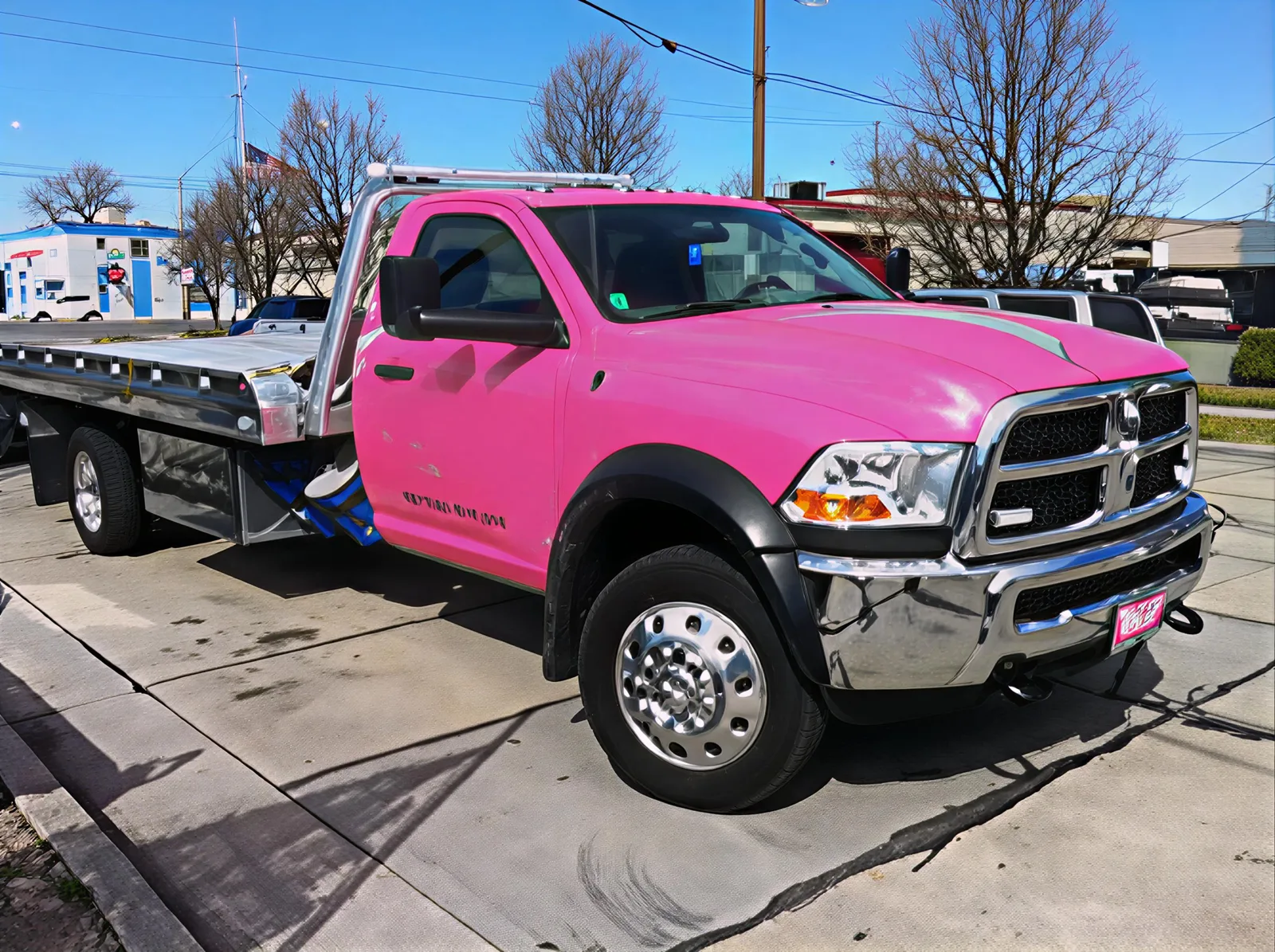
If typing beats talking right now, send dispatch the details with year, make, model, and both addresses. The whole Melbourne service list sits on the coverage page, the standing description lives on the light towing page, and the gallery shows the pink trucks doing exactly this.
Stranded in a lot off Wickham or Eau Gallie? Tell us where you are parked.
(321) 728-1869What People Ask While They Wait.
Have a question this list does not cover? Call, and a dispatcher will give you a straight answer at any hour.
(321) 728-1869My car died in a work parking lot off Wickham. Do I have to wait there the whole time?
How close is your arrival window to what dispatch tells me?
Do you know where the shops are, or do I have to give directions?
The car does not start but the lights work. Is a tow the only option?
Is a small car cheaper than an SUV to tow across town?
Can I ride along to the shop?
Tell Us Where You Are Standing. We’ll Come Get It.
One call reaches a live dispatcher who settles the price before anything moves, gives you a time you can plan around, and sends a pink truck you will spot from across the lot.
(321) 728-1869Rather type it out? Send the details to dispatch or see the pink fleet at work.